DEC 5 | What Does Joel 2:25 Really Mean? The Truth About God Restoring Your Wasted Years
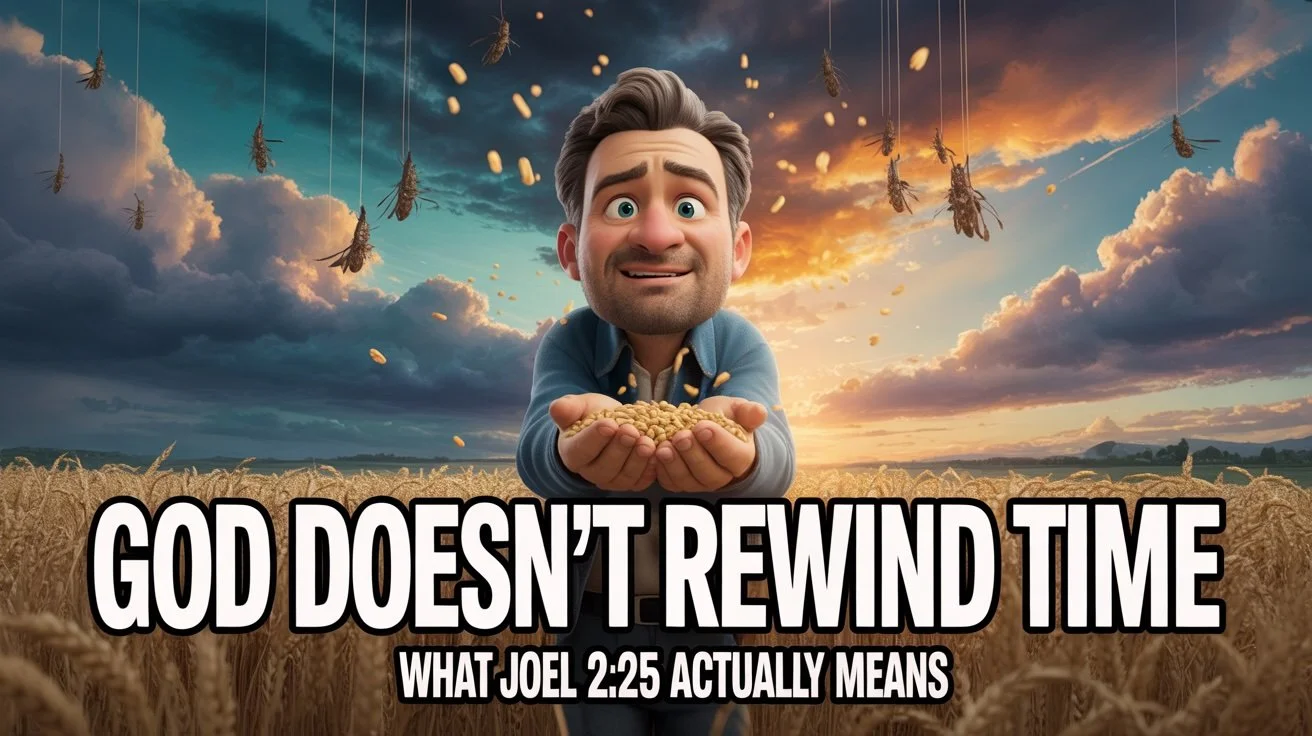
When you understand what this verse actually promises, you'll find something far more powerful than a cosmic do-over.
Have you ever looked back at a chapter of your life and thought, "Those years are just... gone"?
Maybe it was a decade spent in a relationship that ended in betrayal. A career you poured everything into that collapsed overnight. An addiction that consumed your twenties. A church experience that wounded you instead of healed you. Years with your kids you missed because work demanded seventy-hour weeks.
You've probably seen Joel 2:25 quoted on coffee mugs, embroidered on throw pillows, and plastered across Instagram: "I will restore the years the locusts have eaten."
It sounds beautiful. Comforting. Like God is promising to hit some cosmic rewind button and give you a do-over.
But here's the thing—that's not actually what the verse says. And what it does say? It's far more powerful and far more hopeful than any time-travel fantasy could ever be.
The Historical Context You Need to Understand Joel 2:25
Before we can understand what God is promising, we need to understand what actually happened to Joel's original audience.
Joel was a prophet writing to the nation of Israel, likely around 800 BC. His people had just experienced something catastrophic—a locust swarm that devastated their entire agricultural economy. This wasn't a minor inconvenience or a few grasshoppers in the garden. This was complete and total destruction of crops, vineyards, and orchards.
If you've never witnessed a modern locust swarm, it's hard to grasp the scale. In recent years, locust swarms in East Africa have included billions of insects, darkening the sky and consuming everything in their path in a matter of hours. A single swarm can contain 40 to 80 million locusts per square kilometer, and they can travel over 90 miles in a single day.
Joel uses four different Hebrew words to describe these locusts: gazam (swarming locust), arbeh (hopping locust), yeleq (destroying locust), and chasil (cutting locust). Biblical scholars debate whether these represent four developmental stages of the locust or four successive waves of invasion. Either interpretation points to the same devastating reality: layer after layer of loss, wave after wave of destruction, until nothing remained.
This was economic collapse. This was watching everything you worked for disappear. This was staring at empty fields and wondering how you would survive.
What "Restore" Actually Means in Hebrew
Here's where it gets interesting—and where most people miss the real promise.
The Hebrew word translated "restore" in Joel 2:25 is shalam. You might recognize it as the root of a more familiar word: shalom, meaning peace, wholeness, and completeness.
But shalam carries a specific meaning that changes everything about how we read this verse. It means "to make whole, to make complete, to pay back what is owed."
God isn't promising to give back the years themselves. He's promising to restore what those years should have produced.
Think about it carefully. The locusts didn't eat time. They ate crops. They consumed harvests. They destroyed the fruit of the land. And God says: I will give you harvests so abundant that they'll make up for what was lost.
The years are gone. But the fruitfulness isn't.
This distinction matters enormously. God isn't in the business of time travel. He's in the business of transformation. He's not offering to erase your past or pretend it didn't happen. He's promising that your story isn't over—that abundance is still possible, that fruitfulness can still come.
The Uncomfortable Truth About the Locusts
Now we need to address something that might make you uncomfortable. Look at what God calls these locusts in verse 25: "my great army, which I sent among you."
God takes ownership of the devastation.
In Joel's context, the locust plague wasn't random bad luck or unfortunate timing. It was divine discipline, calling Israel back to covenant faithfulness. The locusts were a wake-up call, an invitation to return to God.
This doesn't mean every difficult season in your life is divine punishment. Scripture is clear that we live in a fallen world where suffering happens for many reasons. But Joel's message does remind us that God is sovereign even over our pain—and that discipline from a loving Father is never the end of the story.
The entire point of Joel chapter 2 is restoration after repentance. God isn't a cosmic punisher who enjoys watching His children suffer. He's a Father who disciplines and then heals, who wounds and then binds up, who allows devastation but promises restoration.
Your Locust Years: What They Really Stole
Let's bring this home. What are your locust years?
For some of you, it's obvious. You know exactly which chapter of your life consumed everything you'd built. You can name the years, describe the devastation, and feel the loss even now.
For others, the locusts were more subtle—a slow erosion rather than sudden destruction. Dreams that quietly died. Relationships that gradually withered. Purpose that faded so slowly you didn't notice until it was gone.
Either way, here's the truth we need to accept: those years aren't coming back.
God isn't going to give you back your twenties. He's not going to restore your first marriage or return you to the job you lost or undo the mistakes you made. Time moves in one direction, and no amount of faith changes that fundamental reality.
But—and this is everything—the fruitfulness those years should have produced? That's still on the table.
The harvest you missed? God can give you a harvest now. The growth that was stunted? God can accelerate growth now. The impact you should have made? God can multiply your impact now.
This is why the promise of Joel 2:25 is actually better than time travel. A do-over would mean learning the same lessons again, making new mistakes, facing the same temptations without the wisdom you've gained.
What God offers instead is abundance in your remaining years that wouldn't have been possible without those hard years behind you.
What the Locust Years Produced in You
Here's something we rarely talk about: the locust years weren't only destructive. They were also formative.
The painful seasons—the ones that feel completely wasted—produced something in you that nothing else could have created:
Compassion you wouldn't have otherwise. You understand pain now. You can sit with people in their suffering without offering empty platitudes because you've been there.
Humility you desperately needed. The illusion that you had life figured out? The locusts ate that too. And that's not a loss—that's a gift.
Desperation for God that comfort never creates. Some of us only learn to truly depend on God when every other support has been stripped away.
Wisdom that only comes through failure. You know what doesn't work now. You know your weaknesses. You know your limits. That knowledge is invaluable.
What if restoration doesn't mean erasing those years but redeeming them? What if God's plan isn't to pretend the locusts never came but to use what they left behind?
The Promise That Follows: More Than Restoration
The verses immediately following Joel 2:25 paint a picture of abundance that goes beyond simple recovery:
"You shall eat in plenty and be satisfied, and praise the name of the LORD your God, who has dealt wondrously with you. And my people shall never again be put to shame." (Joel 2:26)
Notice that phrase: "dealt wondrously with you."
Not "dealt wondrously despite your circumstances." Not "dealt wondrously after your suffering ended." God dealt wondrously with them through the entire experience—including the locusts.
This is the scandalous claim of biblical faith: God wastes nothing. Not your pain. Not your failures. Not even the years you threw away through your own stupidity. Every season, even the devastating ones, becomes raw material for His redemptive purposes.
You'll eat in plenty. You'll be satisfied. And you'll praise—not because you got your old life back, but because you got something better.
A Practical Response to Joel 2:25
So what do we do with this? How do we move from understanding to application?
First, grieve honestly. Don't spiritualize your loss or pretend it didn't hurt. The Israelites didn't skip straight to restoration—they went through a season of mourning, fasting, and honest lament. Your locust years were real. The loss was real. Acknowledge it.
Second, stop waiting for a rewind. As long as you're hoping God will somehow give you back what's gone, you'll miss what He's offering now. The harvest isn't behind you—it's ahead of you.
Third, ask different questions. Instead of "Why did this happen?" or "Can I get those years back?", try asking: "What did those years prepare me for?" and "What harvest is possible now that wasn't possible before?"
Fourth, look for the abundance. Joel's promise isn't that life will return to normal. It's that God will provide so abundantly that the locust years become a footnote rather than the headline. Start looking for evidence of that abundance—it may already be appearing in ways you haven't recognized.
Fifth, let your story serve others. Your locust years qualify you to speak hope into someone else's devastation. The compassion and wisdom you gained weren't just for you—they were for everyone God puts in your path who's watching their own fields get consumed.
The God Who Wastes Nothing
Here's what I want you to walk away with: The promise of Joel 2:25 isn't a cosmic undo button. It's something far more profound.
It's the promise that the God who calls locusts His army also promises to restore what they've eaten. Both things are true. Both things are grace.
Your wasted years taught you things that comfort never could. Your failures qualified you to help others in ways success never would. Your devastation became the soil for a harvest that wouldn't have grown in easier ground.
God isn't going to give you back your twenties, your first marriage, your missed opportunities, or your stolen dreams. But He's offering something better: abundance in your remaining years that makes the locust years look like preparation rather than punishment.
The story isn't over. Fruitfulness is still possible. And the God who allowed the locusts is the same God who promises the harvest.
That's not a coffee mug sentiment. That's a reason to hope.
Your Next Step
This week, take five minutes for a simple exercise. Write down what you'd call your "locust years"—the seasons that feel wasted, consumed, lost.
Then ask God—not to erase them, not to give them back—but to redeem them. Ask Him to show you what those years prepared you for. Ask Him what harvest is possible now that wasn't possible before.
The locusts came. That part of the story is written.
But the restoration? That chapter is still being written. And it's going to be better than you think.
What are your locust years? And what might God be preparing to restore? Share your thoughts in the comments below—your story might be exactly what someone else needs to hear today.

An Invitation to go Deeper….
If today’s message spoke to you, join the FaithLabz 30-Day Prayer Challenge and strengthen your connection with God’s unshakable love. You are never alone—let’s grow together!