DEC 7 | When the Map Runs Out: Finding Faith in Life's Uncertain Seasons
What Happens When You Can't See the Next Step?
Your GPS just died. You're somewhere between where you were and where you're supposed to be. And you have absolutely no idea what comes next.
That's not a nightmare scenario. That's actually the biblical definition of faith.
If you've ever felt stuck between chapters of your life—between jobs, between relationships, between the faith you grew up with and whatever comes next—then you're in good company. In fact, you're in the same position as the most celebrated figure of faith in the entire Bible.
Hebrews 11:8 contains just twenty-nine words in English, but it might be the most uncomfortable sentence in Scripture for anyone who likes having a plan: "By faith Abraham, when called to go to a place he would later receive as his inheritance, obeyed and went, even though he did not know where he was going."
Even though he did not know where he was going.
Let that sink in for a moment. The father of faith, the patriarch we're all supposed to emulate, built his entire legacy on walking out the door without a destination programmed.
The Problem With Needing to Know Everything
Here's an honest confession: I struggle with this verse. I've got spreadsheets for my spreadsheets. I like knowing what's coming. I find comfort in that little blue dot on Google Maps telling me exactly where I am and precisely how many minutes until I arrive.
But Abraham? His entire claim to fame is that he embraced uncertainty as a lifestyle.
We live in a culture that worships certainty. We want five-year plans, guaranteed outcomes, and step-by-step instructions for everything from building IKEA furniture to building a meaningful life. The idea of stepping forward without knowing where we'll land feels irresponsible at best and terrifying at worst.
Yet here's the biblical model of faith, and it looks nothing like a detailed roadmap.
Understanding the Context: Who Wrote Hebrews and Why It Matters
To truly grasp the power of Hebrews 11:8, we need to understand who first received these words.
The letter to the Hebrews was written around 65 AD, most likely to Jewish Christians who found themselves caught between two worlds. They had left behind the familiar rhythms of temple worship—the sacrifices, the festivals, the centuries of tradition that shaped their identity. But the new thing? The early church? It was messy, persecuted, and profoundly uncertain.
These early believers were experiencing what scholars call a liminal space.
The word "liminal" comes from the Latin "limen," meaning threshold—the doorway between rooms. When you're in a liminal space, you're no longer in the old room, but you haven't arrived in the new one yet. You're just standing in the door frame, belonging fully to neither space.
And to these threshold-dwellers, the writer says, "Let me tell you about Abraham."
What Abraham Actually Left Behind
Around 2000 BC, Abraham lived in Ur of the Chaldeans—a location in modern-day Iraq. This wasn't some backwater village. Ur was one of the most sophisticated cities of the ancient world. It had advanced infrastructure, running water, and remarkable astronomical knowledge. Abraham's family had roots there going back generations.
He had security. He had familiarity. He had everything our modern souls crave.
And God said one word: "Leave."
The Greek Words That Change Everything
This is where the original language reveals something powerful that English translations can miss.
The word translated as "obeyed" in Hebrews 11:8 is the Greek word hypēkousen (ὑπήκουσεν). It literally means "to hear under"—to position yourself beneath something you're hearing. This isn't passive agreement or casual compliance. It's the deliberate choice to place yourself under the authority of the voice speaking to you.
Abraham didn't just hear God's call. He restructured his entire life around it.
And that phrase—"not knowing where he was going"? In Greek, it's mē epistamenos (μὴ ἐπιστάμενος). This describes genuine uncertainty, not false humility. Abraham wasn't being coy or pretending not to know. He legitimately did not have the destination.
He had a direction. He had a voice. He had a promise.
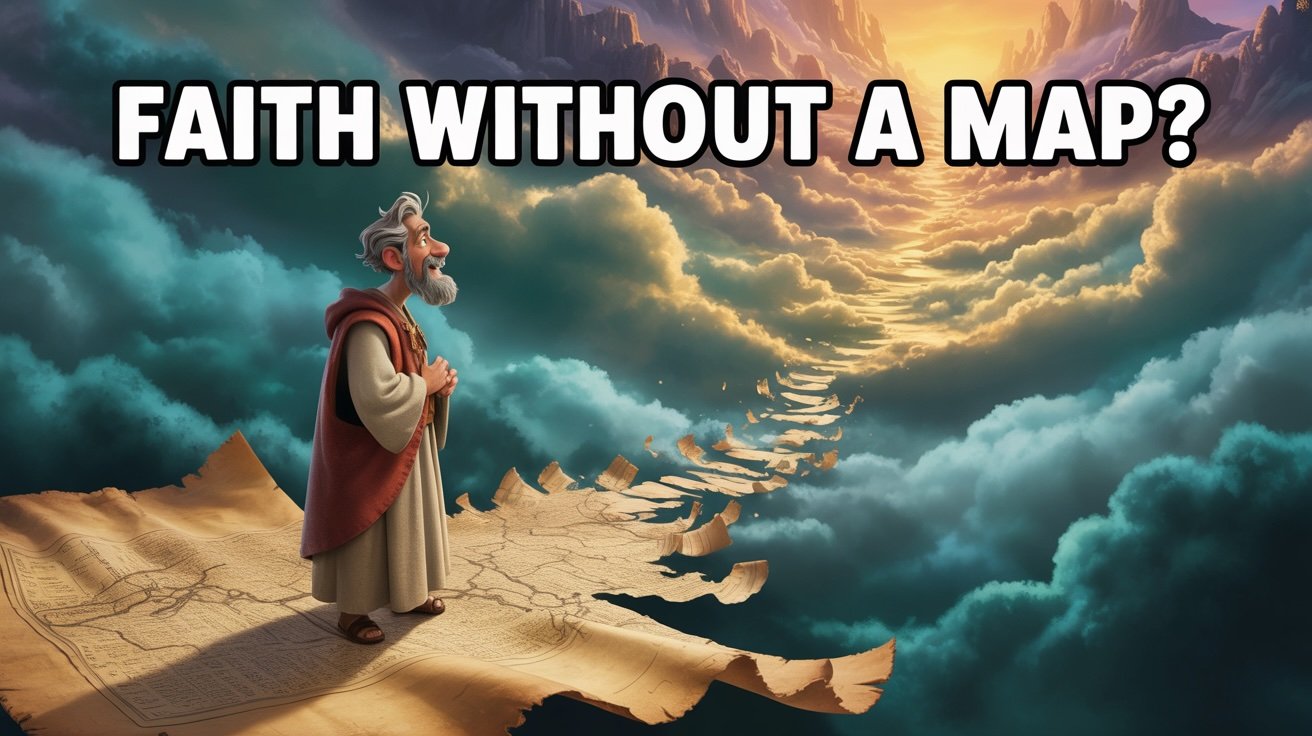
But he did not have a map.
And he went anyway.
Why Advent Is the Most Liminal Season
If you're reading this during the Advent season, this connection becomes even more profound.
Advent is the most liminal season in the Christian calendar. The entire purpose of these four weeks is to commemorate waiting. The Jewish people waited thousands of years for the Messiah. Mary waited nine months carrying a miracle she couldn't fully explain to anyone. The shepherds waited in the darkness until angels suddenly tore open the sky.
And us? We're still waiting. Christ came, yes—that's what Christmas celebrates. But Christ is also coming again. The kingdom has been inaugurated but not yet consummated. We live in the theological tension that scholars call the "already but not yet."
What does that mean practically? It means the entire Christian life is a liminal space. We're all Abraham. We've heard the voice. We've left some things behind. And we don't have the complete picture of where this journey ends.
Why the In-Between Feels So Wrong
Here's something nobody tells you about liminal spaces: they feel like something is broken.
When you're between jobs and can't see what's next—it feels wrong.
When you've outgrown your childhood faith but haven't figured out what you actually believe now—it feels wrong.
When you've ended a relationship and aren't sure who you are without it—it feels wrong.
When you're grieving who you used to be but can't yet see who you're becoming—it feels wrong.
The discomfort of uncertainty often masquerades as evidence that we've made a mistake, that God has abandoned us, or that we're hopelessly lost.
But what if liminal space isn't the absence of God's guidance? What if it's actually the presence of something deeper?
Abraham could have stayed in Ur and maintained certainty. He could have kept the map. He chose the voice instead.
The City With Foundations
Look at what Hebrews says immediately after describing Abraham's journey into the unknown. Verse 10 reveals his motivation: "For he was looking forward to the city with foundations, whose architect and builder is God."
This changes everything.
Abraham wasn't wandering aimlessly. He wasn't stumbling through the wilderness hoping for the best. He was walking toward something he couldn't see yet—a city designed by God himself.
The map had run out, but the Mapmaker hadn't gone anywhere.
This is the crucial distinction between biblical faith and reckless presumption. Faith isn't closing your eyes and hoping you don't fall off a cliff. Faith is trusting the Guide when you can't see the path. It's the confidence that the One who called you also knows exactly where you're going, even when you don't.
The Difference Between Destination and Direction
We often confuse knowing our destination with having direction. But these are two very different things.
A destination is a specific point on a map—coordinates you can plug into your GPS. A direction is a orientation, a trajectory, a steady movement toward something even when you can't see it clearly.
Abraham had direction without destination. He knew he was moving toward promise, toward blessing, toward a future secured by God's word. He just couldn't see the specifics yet.
Most of us are waiting for the destination before we're willing to move. God often works the opposite way—he gives us just enough direction for the next step, and the destination becomes clear only as we walk.
Practical Application: Embracing Your Liminal Season
So what does this mean for your life right now?
Maybe you're navigating a liminal space as you read this. You've left something behind—a job, a belief system, a relationship, a version of yourself—and you haven't arrived anywhere new yet. You're standing in the doorway, and it's deeply uncomfortable.
Here's the one truth I want you to carry with you: Liminal is not lost.
Write that down. Say it out loud. Let it sink into the anxious places of your soul that keep insisting uncertainty equals abandonment.
Abraham's story testifies to something counter-intuitive: the space between certainty and arrival is where faith actually lives. You cannot exercise faith when you already have the map. Faith requires the map to run out.
An Advent Invitation
This Advent season, instead of rushing toward Christmas—instead of manufacturing certainty through busyness and distraction—what if you let yourself sit in the threshold?
What if you trusted that the One who called you is the same One who knows exactly where you're going, even when you don't?
What if the map running out isn't the crisis you think it is? What if it's actually the invitation?
You're not lost. You're between chapters. And the Author of your story? He's still writing.
The mist ahead isn't emptiness. It's the space where faith does its most important work.
A Prayer for the In-Between
God, I confess that I want the map more than I want to trust the Mapmaker. The uncertainty of this season feels like abandonment, but I'm choosing to believe it might be invitation. Give me Abraham's courage to hear under your voice—to position my whole life beneath your call even when I can't see where it leads. Help me remember that liminal is not lost. You are the architect of the city I'm walking toward, and you don't lose your children in the threshold. I trust you with the next step, even when I can't see beyond it. Amen.
Join the Conversation
If you're navigating a liminal space right now—a doorway, a threshold, an uncertain in-between—you're not alone. Sometimes the most powerful thing we can do is simply name where we are.
What threshold are you standing in today? What map has run out in your life? Share in the comments below, not because you need advice, but because naming our uncertainty is often the first step toward finding peace within it.
Someone else needs to know they're not the only one standing in the door frame.

An Invitation to go Deeper….
If today’s message spoke to you, join the FaithLabz 30-Day Prayer Challenge and strengthen your connection with God’s unshakable love. You are never alone—let’s grow together!