DEC 18 | Forgiving the Mirror: What Psalm 139 Says About the Body You Can't Stop Criticizing
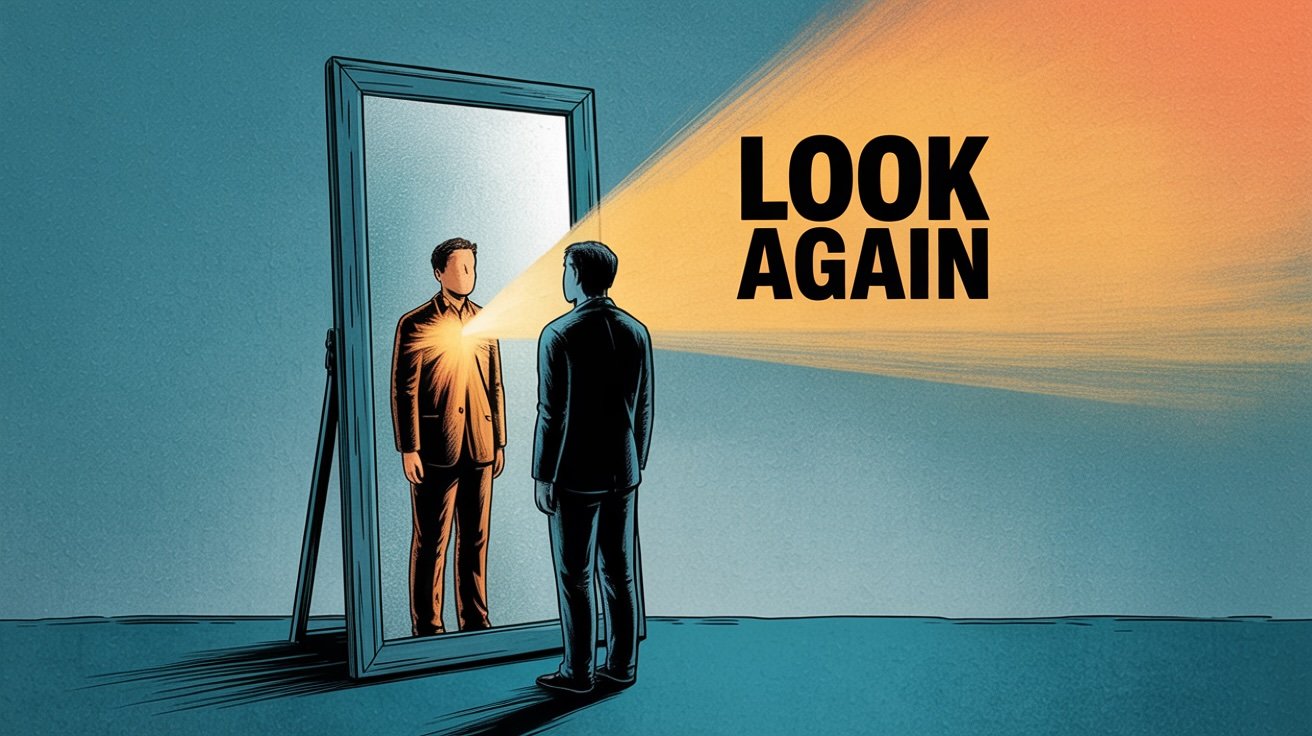
Key Passage: "I praise you because I am fearfully and wonderfully made; your works are wonderful, I know that full well." — Psalm 139:14 (NIV)
Big Idea: The mirror shows you a body; God sees a beloved image-bearer worth beholding.
What this will give you today: A way to stand in front of your reflection without the quiet cruelty—and a path toward seeing yourself the way you were meant to be seen.
Here's what I'm not going to do: tell you to "just love yourself" like it's a switch you flip. Or throw a Bible verse at your body image struggles and call it healing.
What I am going to do is walk with you through one of the most honest passages in Scripture about how God sees the human body—and why that might change what happens the next time you catch your reflection.
This isn't about pretending you don't have complicated feelings about your body. It's about asking a different question than "How do I look?" What if the real question is: Who is doing the looking?
Psalm 139:14 isn't a pep talk. It's an invitation to see yourself through older, kinder eyes.
Let's go there together.
The moment you realize this is about you
Picture this: You're getting ready in the morning. You glance at the mirror—just a glance—and something tightens in your chest. Maybe it's the way your shirt fits. Maybe it's the number you saw on the scale yesterday. Maybe it's something you can't even name, just a low hum of disappointment that's been there so long you've stopped noticing it.
You finish getting dressed. You go about your day. But somewhere underneath everything else, there's a quiet verdict running in the background: Not enough. Too much. Wrong.
Most of us don't talk about this. We assume everyone else has made peace with their body, and we're the only ones still fighting. But the truth is, the mirror has become a courtroom for millions of people—and we've appointed ourselves as both prosecutor and judge.
Here's what nobody tells you: that voice isn't neutral. It's not "just being honest." It's a script you inherited from somewhere, and it's overdue for an audit.
The common assumption that quietly drains people
There's a belief most of us carry without ever saying it out loud:
My body is a problem to be solved.
We treat our bodies like projects. Like something to optimize, fix, or apologize for. We scroll past images of people who seem to have figured it out, and we assume the answer is more discipline, more effort, more control.
But here's the thing: you can't hate yourself into wholeness.
You can't criticize your way to peace.
And you can't earn the right to exist in your own skin.
The "body as problem" framework keeps us stuck in an exhausting loop—forever measuring, comparing, and coming up short. It turns the mirror into an enemy. And it makes us forget something essential: you are not your body's manager. You are its resident.
Your body isn't a project. It's a home. And homes aren't meant to be judged—they're meant to be lived in.
What the passage actually says when you slow down
Psalm 139 is one of the most intimate chapters in the entire Bible. David isn't preaching to a crowd here—he's praying in the dark. He's reflecting on a God who knows him completely: his thoughts, his movements, his words before he speaks them.
And then he lands on this:
"I praise you because I am fearfully and wonderfully made; your works are wonderful, I know that full well."
Let's slow down.
"Fearfully" doesn't mean David is scared of his own body. The Hebrew word here (yare) carries the sense of awe, reverence, wonder. It's the kind of fear you feel standing at the edge of the Grand Canyon—not terror, but astonishment at something vast.
"Wonderfully made" translates a word (palah) that means "set apart, distinguished, extraordinary." Not ordinary. Not mass-produced. Singular.
David is saying: when I consider how I was made—the intricacy, the intentionality, the sheer creative force behind my existence—the only appropriate response is praise.
But notice something important: this isn't self-worship. David isn't praising himself. He's praising the Maker. The wonder isn't "look how great I am." The wonder is "look at what God has done."
This is the Imago Dei—the image of God—in action. Genesis tells us that humans are made in the image of God, and that means every body carries a reflection of the divine. Not because our bodies are perfect. But because they are purposed.
Your body is not a mistake to be corrected. It's a canvas that already bears a signature.
When you look in the mirror, you're not just seeing skin and bone and imperfection. You're seeing the fingerprints of a Creator who doesn't make junk.
Here's the twist: David says "I know that full well." But do we?
Most of us know it intellectually. We could pass the theology quiz. But knowing it in our bones—that's different. That's where the real work begins.
Where this shows up in real life
Think about the last time you took a photo and immediately deleted it. Or the way you apologize before showing up somewhere—"Sorry, I look like a mess." Or the mental math you do before eating, as if food requires justification.
These aren't small things. They're symptoms of a fractured relationship with your own body.
Picture this: You're walking through an art museum, and you come across a painting by a master. The brushstrokes are visible. The colors aren't quite what you'd expect. Parts of it feel unfinished.
But you wouldn't stand there and critique it, would you? You wouldn't say, "This painting should be ashamed of itself." You'd recognize that it carries the mark of its maker—and that's what makes it valuable.
Now imagine God walking through a gallery of every human being ever made. He stops at you.
And what He sees is not a problem to be fixed. He sees His own image, reflected back. He sees intention. He sees someone worth beholding.
Forgiving the mirror starts with believing that the Artist knew what He was doing.
Five small practices for this week
1. Pause before the mirror.
Do this: Before you look at your reflection tomorrow, take one breath and say—out loud or in your mind—"I am looking at an image-bearer."
Why it matters: It reframes the moment before the inner critic gets a word in. You're not approaching the mirror as judge. You're approaching it as witness.
Breath prayer: "You made me. Help me see what You see."
2. Name the script.
Do this: The next time you catch yourself criticizing your body, pause and ask: Where did I learn this? Was it a comment from childhood? A cultural standard? A comparison you made once and never let go of?
Why it matters: Unnamed scripts have power. Once you recognize where the voice came from, you can start to question whether it's true—or just old.
Breath prayer: "That voice is not Yours, Lord. Quiet it."
3. Thank your body for one thing.
Do this: At some point today, thank your body for something it did—carried you up the stairs, let you taste your coffee, allowed you to hug someone.
Why it matters: Gratitude rewires the relationship. It shifts you from adversary to ally.
Breath prayer: "Thank You for this body that holds me."
4. Replace "I hate" with "I'm learning to accept."
Do this: When a harsh thought comes—"I hate my stomach" or "I hate how I look in this"—interrupt it. Replace the sentence with: "I'm learning to accept my stomach. It's part of me, and I'm not done growing."
Why it matters: "I hate" is a closed door. "I'm learning" is an open one. You don't have to fake positivity—just leave room for movement.
Breath prayer: "You are patient with me. Help me be patient with myself."
5. Fast from the comparison feed.
Do this: For one day this week, unfollow or mute the accounts that make you feel worse about your body. Even temporarily.
Why it matters: You can't heal in the same environment that's wounding you. Curate your inputs like your peace depends on it—because it does.
Breath prayer: "Guard my eyes. Guard my heart."
When this feels hard: the 3 pushbacks people feel
The emotional pushback: "I've hated my body for so long. I don't know how to stop."
I know. This isn't a switch you flip. It's a direction you walk. You don't have to arrive at self-love by Friday. You just have to stop agreeing with the cruelty. Start with neutrality if kindness feels too far. Start with, "This is my body. It's allowed to exist." That's enough for today.
The practical pushback: "But what about health? Isn't it okay to want to change?"
Yes—caring for your body is good. But there's a difference between stewardship and punishment. One says, "I'm caring for this body because it matters." The other says, "I'm fixing this body because it's broken." Check your motive. If the goal is fueled by shame, the results won't bring peace. Health rooted in hatred isn't health.
The theological pushback: "Doesn't focusing on my body seem shallow or self-centered?"
Here's what I'd gently push back on: ignoring your body isn't holiness. Scripture doesn't tell us to transcend the body—it tells us we'll be resurrected in one. God became flesh. Bodies matter to Him. Learning to see your body as He sees it isn't vanity. It's worship in skin and bone.
Questions people ask about this
How do I stop comparing myself to others?
Comparison is a habit, which means it can be unlearned. Start by noticing when it happens without judging yourself for it. Then gently redirect: "That person's body is not my assignment. Mine is." Over time, awareness weakens the reflex. You're not broken for comparing—you're human. Just don't let it have the final word.
What if I've tried to accept my body and it never sticks?
Healing isn't linear. Some days you'll feel peace; other days the old voices will return. That doesn't mean you've failed—it means you're still in process. The goal isn't perfection. It's persistence. Keep returning to what's true, even when it doesn't feel true yet. Repetition builds new grooves.
Does God really care about how I feel about my body?
Yes. Because you care about it—and you are His child. God isn't indifferent to your pain. He's close to the brokenhearted (Psalm 34:18), and that includes the heartbreak of never feeling at home in your own skin. Bring it to Him. He can handle it.
Reflection questions
When you look in the mirror, what's the first thought that usually comes? Where do you think that thought originated?
What would change if you believed—really believed—that your body was made with intention and purpose?
Is there a specific part of your body you've been at war with? What would it look like to call a truce, even for a week?
How has comparison shaped the way you see yourself? What would your life look like with less of it?
What's one kind thing you could say to your body today that you've never said before?
A closing blessing that doesn't feel cheesy
You are not a rough draft.
You are not an apology.
You are not a before photo waiting for an after.
You are a living, breathing, image-bearing human being—crafted with care by a God who does not make mistakes.
May you learn to see yourself with the same kindness He already sees you with. May the mirror become less of a courtroom and more of a quiet place of recognition. And may you walk through this week knowing that you are fearfully, wonderfully, and purposefully made.
You are allowed to take up space.
You are allowed to be here.
Go in peace.

An Invitation to go Deeper….
If today’s message spoke to you, join the FaithLabz 30-Day Prayer Challenge and strengthen your connection with God’s unshakable love. You are never alone—let’s grow together!