🌿Paul: Apostle of Grace & Transformation | Deep Dive for Adults
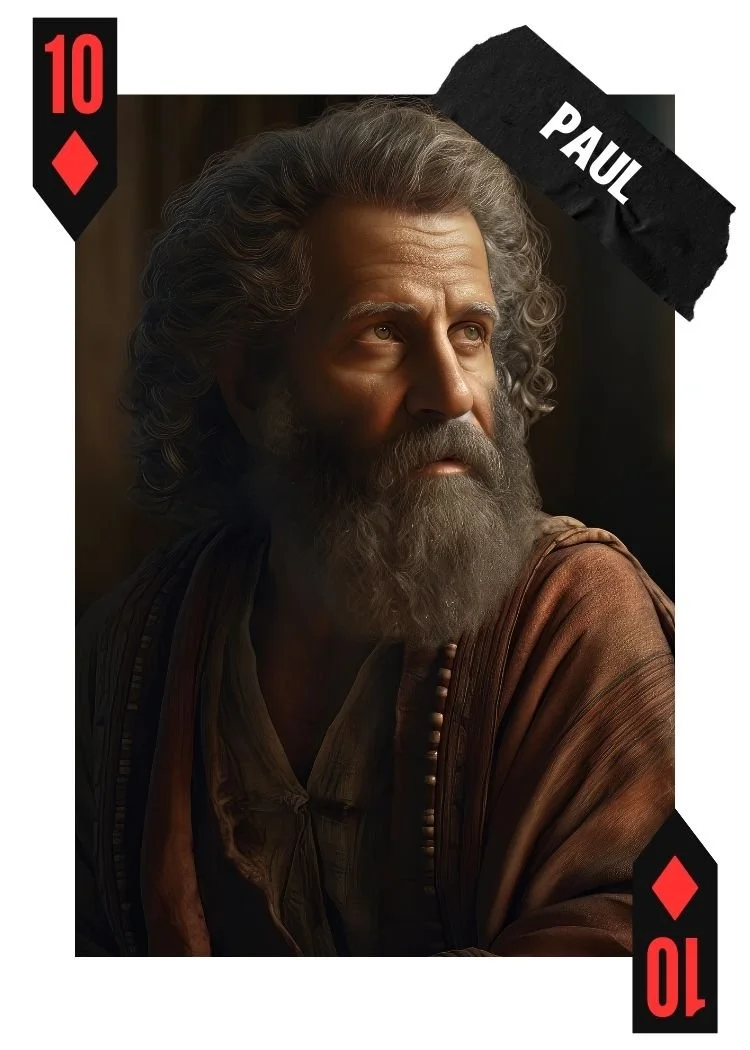
Meet Paul
Paul of Tarsus stands as one of Christianity's most influential and transformative figures ✨. From zealous persecutor to passionate apostle, his dramatic conversion and subsequent ministry revolutionized the early church and shaped Christian theology for millennia to come 🌟.
Known as the "Apostle to the Gentiles," Paul's missionary journeys, profound letters, and unwavering faith despite extraordinary hardships demonstrate the remarkable power of God's grace to transform lives completely ✝️. His journey from Saul the persecutor to Paul the apostle reminds us that no one is beyond redemption and that God often works through the most unexpected individuals to accomplish His divine purposes 💫. Through shipwrecks, imprisonments, and countless trials, Paul's unwavering commitment to spreading the gospel continues to inspire believers today, challenging us to examine our own faith journey and commitment to Christ's calling in our lives 🔥.
📜 Historical Background 📜
Paul was born as Saul in Tarsus (in modern-day Turkey) around 5 AD, during the height of the Roman Empire 🏛️. As a Jewish Roman citizen, he enjoyed privileges many Jews of his time did not possess, including protection under Roman law and the right to appeal directly to Caesar 📜. Raised in a devout Jewish family, he studied under the renowned Rabbi Gamaliel in Jerusalem, becoming a Pharisee and expert in Jewish law and tradition 📖.
The historical context of Paul's life was one of religious and political tension 🌍. The Roman occupation of Judea created ongoing conflicts with Jewish religious authorities, while various Jewish sects debated interpretations of scripture and the coming of the Messiah ⚔️. Christianity emerged as a controversial new movement within Judaism, which Paul (as Saul) initially viewed as dangerous heresy that threatened the faith of his ancestors 🔥.
Paul lived in an urbanized, Hellenistic world where Greek culture, language, and philosophy permeated society, even in Jewish communities 🏺. This multicultural background uniquely positioned him to later bridge theological concepts between Jewish and Gentile audiences in his ministry ✝️. His tent-making trade (Acts 18:3) represented the typical skilled craftsman profession of his day, allowing him mobility and self-sufficiency during his later missionary journeys 🧵.
Scripture places Paul at the stoning of Stephen (Acts 7:58-8:1), marking his early role as a persecutor of Christians before his dramatic conversion on the Damascus Road (Acts 9:1-19) 🌩️. This transformation from persecutor to apostle occurred approximately 33-36 AD, setting the stage for his later missionary journeys throughout the Mediterranean world and his authorship of at least 13 New Testament epistles that would fundamentally shape Christian theology and practice for centuries to come 📬.
⏳ Key Events & Turning Points ⏳
🌩️ The Damascus Road Conversion
Paul's life dramatically changed on the road to Damascus, where he traveled with official letters authorizing him to arrest followers of "the Way" (early Christians) 📜. A blinding light from heaven struck him down, and he heard the voice of Jesus himself asking, "Saul, Saul, why do you persecute me?" (Acts 9:4) ✨. This supernatural encounter left him physically blind for three days—a powerful metaphor for his spiritual blindness despite his religious knowledge.
When Ananias, a Christian whom God specifically sent, laid hands on Paul, "something like scales fell from his eyes" (Acts 9:18), restoring both his physical and spiritual sight 👁️. This pivotal moment transformed the church's greatest enemy into its most ardent advocate, demonstrating God's power to completely reorient a human heart. The persecutor became the persecuted, as Paul immediately began proclaiming in synagogues that Jesus was indeed the Son of God, confounding his former allies and forcing him to escape Damascus under the cover of darkness 🌙.
🌊 Missionary Journeys and Church Planting
Paul embarked on three extensive missionary journeys throughout the Mediterranean world, covering thousands of miles by foot and sea 🚶♂️🚢. His strategic approach focused on major urban centers like Ephesus, Corinth, and Thessalonica, where he would first visit local synagogues to share the gospel with fellow Jews before reaching out to Gentiles 🏙️.
During these journeys, Paul established numerous churches, nurturing new communities of believers who often faced intense persecution 🔥. His missionary strategy was revolutionary—rather than requiring Gentile converts to first become Jewish, Paul advocated for direct access to salvation through faith in Christ alone, a position formalized at the Council of Jerusalem (Acts 15) 📜. This theological breakthrough opened Christianity to people of all ethnic backgrounds, fundamentally changing the nature of the early church from a Jewish sect to a universal faith ✝️.
⛓️ Imprisonments and Letters
Paul's bold proclamation of the gospel frequently landed him in prison, where he authored many of his most profound epistles 📝. His "prison epistles" (Ephesians, Philippians, Colossians, and Philemon) reflect a mature faith that transcended his physical circumstances, demonstrating how suffering had deepened rather than diminished his relationship with Christ 💫.
During his Roman imprisonment, though chained and awaiting trial, Paul continued ministering to visitors and writing letters that addressed specific challenges in various churches 🏛️. These letters provided practical guidance on matters from church leadership to personal ethics, while also articulating profound theological concepts like justification by faith, adoption into God's family, and the mystery of the church as Christ's body 📬. Even in chains, Paul's influence expanded throughout the empire, fulfilling God's words that he was "a chosen instrument to carry my name before Gentiles, kings, and the children of Israel" (Acts 9:15) 👑.
🌟 Endurance Through Suffering
Perhaps no biblical figure outside of Jesus himself endured more suffering for the gospel than Paul. In 2 Corinthians 11:23-28, he catalogs a staggering list of hardships: multiple beatings, repeated imprisonments, five times receiving 39 lashes, three shipwrecks, constant dangers, sleepless nights, hunger, and thirst 💔. Through it all, he discovered that God's grace was sufficient and that divine power was "made perfect in weakness" (2 Cor 12:9) 💪.
Paul's response to suffering revolutionized the Christian understanding of hardship. Rather than viewing trials as divine punishment or absence, he saw them as opportunities for spiritual growth and identifying with Christ's sufferings 🌱. His famous "thorn in the flesh" (2 Cor 12:7-10), whatever its exact nature, taught him to embrace limitations as pathways to experiencing God's strengthening grace 🙏. This perspective continues to comfort and inspire believers facing their own trials, offering a framework for finding purpose and even joy amid suffering 🌈.
🌟 Life Lessons & Modern Applications 🌟
💞 Radical Transformation is Possible
Paul's journey from zealous persecutor to passionate apostle demonstrates that no one is beyond the reach of God's transforming grace 🔄. His life challenges us to avoid writing people off as "too far gone" or unchangeable. In today's polarized society, where we often dismiss those with opposing viewpoints, Paul's story invites us to recognize that the most unlikely individuals might become powerful agents for good when touched by divine grace ✨.
Consider the modern applications: The addict who becomes a counselor helping others find recovery; the former criminal who dedicates their life to prison ministry; the corporate executive who leaves a lucrative career to serve vulnerable populations 🌱. These modern transformations echo Paul's ancient one, reminding us that our identities are not fixed by our worst mistakes but can be radically reshaped by encounter with divine love 💓.
🌍 Cultural Bridge-Building
As a Roman citizen, Jewish scholar, and Greek speaker, Paul navigated multiple cultural worlds effectively 🌉. He modeled contextualizing the gospel without compromising its core truths, famously becoming "all things to all people" to win some to Christ (1 Cor 9:22) 🔄. This ability to translate eternal truths into culturally relevant language remains essential in our globalized, multicultural world 🌐.
Today's Christians face the challenge of communicating ancient faith in contemporary contexts—whether across generational divides, in digital spaces, or amid diverse worldviews 📱. Paul's approach teaches us to deeply understand both our message and our audience, finding points of connection while maintaining integrity. His Mars Hill address (Acts 17) offers a masterclass in engaging philosophical minds by acknowledging truth in their thinking while gently redirecting toward fuller understanding in Christ 🧠.
🔥 Purpose Through Adversity
Paul's response to suffering transforms our understanding of life's inevitable hardships 🌩️. Rather than viewing trials as punishment or meaningless pain, he recognized them as opportunities for spiritual formation and greater dependence on God. His famous declaration that "we rejoice in our sufferings" because they produce character and hope (Romans 5:3-5) offers a revolutionary perspective on adversity 💪.
In our comfort-seeking culture, Paul's example challenges the notion that happiness equals absence of difficulty 🛋️. Instead, he points to a deeper joy found in purposeful suffering and identification with Christ. For the parent of a child with special needs, the entrepreneur facing repeated setbacks, or the individual battling chronic illness, Paul's perspective offers a framework for finding meaning and growth through life's greatest challenges, not despite them 🌱.
✝️ Living from Grace, Not for Approval
Perhaps Paul's most profound contribution was articulating that we are saved by grace through faith, not by religious performance or moral achievement (Ephesians 2:8-9) 🎁. This revolutionary understanding liberates believers from the exhausting treadmill of trying to earn divine favor or human approval ⛓️.
In today's achievement-oriented culture, where worth is often measured by productivity, appearance, or social media metrics, Paul's message remains profoundly countercultural 📱. It speaks to the executive burning out trying to prove their value, the teenager anxious about social acceptance, and the religious person caught in cycles of shame and moral effort. Paul's theology reminds us that our core identity rests in being loved and accepted by God first, with good works flowing from that secure foundation rather than attempting to establish it 💓.
💬 Inspiring Quotes or Passages 💬
🌬️ "I have been crucified with Christ and I no longer live, but Christ lives in me. The life I now live in the body, I live by faith in the Son of God, who loved me and gave himself for me." (Galatians 2:20)
This profound statement captures the essence of Paul's understanding of Christian identity. He invites us to consider what it means to die to our old self-centered existence and live from a new center—Christ within us. In a world obsessed with self-actualization, Paul offers the paradoxical wisdom that we find our truest selves by surrendering to Christ's indwelling presence 🧠.
🌬️ "And we know that in all things God works for the good of those who love him, who have been called according to his purpose." (Romans 8:28)
This isn't shallow optimism but hard-won wisdom from someone who endured extraordinary suffering. Paul doesn't claim all things are good, but that God works redemptively through all circumstances. This offers profound hope when facing life's greatest challenges, assuring us that nothing we experience is wasted in God's economy of grace ✨.
🌬️ "For I am convinced that neither death nor life, neither angels nor demons, neither the present nor the future, nor any powers, neither height nor depth, nor anything else in all creation, will be able to separate us from the love of God that is in Christ Jesus our Lord." (Romans 8:38-39)
This triumphant declaration of God's inseparable love provides an unshakable foundation for Christian confidence. When doubts arise or circumstances suggest abandonment, Paul's words remind us that divine love transcends every conceivable barrier. In our anxious age, this assurance speaks powerfully to fears of isolation and rejection 💗.
🌬️ "But he said to me, 'My grace is sufficient for you, for my power is made perfect in weakness.' Therefore I will boast all the more gladly about my weaknesses, so that Christ's power may rest on me." (2 Corinthians 12:9)
This counterintuitive embrace of weakness revolutionizes how we view our limitations. Rather than hiding or overcoming our frailties, Paul suggests they become channels for experiencing divine strength. This liberates us from exhausting perfectionism and invites us to find God most powerfully in our most vulnerable places 💪.
🌼 Reflection & Call to Action 🌼
Paul's extraordinary journey from persecutor to apostle invites deep personal reflection on our own spiritual transformations 🧠. How might God be working to reshape your understanding, priorities, or direction in ways that seem uncomfortable or unexpected? Like Paul, are there cherished beliefs or identities you need to surrender to embrace a fuller vision of God's calling on your life? Consider journaling about areas where you sense divine disruption that might actually be redemptive transformation in disguise 📝.
The apostle's life also challenges us to examine our response to suffering and limitation 🔄. When facing your own "thorns in the flesh"—whether physical illness, relational difficulties, or persistent struggles—do you primarily seek escape and comfort, or have you learned to discover grace sufficient for each day? This week, try identifying one current challenge and specifically asking God to reveal how His strength might be perfected through this very weakness 💪.
Paul's missionary zeal compels us to consider our own participation in sharing Christ's love 🌍. While not everyone is called to international missions, each believer has spheres of influence where they can live as ambassadors of reconciliation (2 Cor 5:20). What specific steps might you take to more intentionally represent Christ in your workplace, neighborhood, or family? Consider identifying one relationship where you can more deliberately demonstrate Christ's love through practical action this week 🤝.
Finally, Paul's theology of grace invites us to examine the foundations of our spiritual life 🌱. Are you primarily motivated by trying to earn God's approval or by grateful response to grace already received? Take time this week to meditate on Ephesians 2:8-10, asking God to show you areas where performance-orientation might be robbing you of the freedom Christ secured. Consider implementing a daily practice of beginning each morning by consciously receiving God's love and acceptance before any work or service begins 🙏.
🌿 Prayer & Meditation 🌿
Divine Transformer of Lives 🔄,
We stand in awe of how You redirected Paul's passionate nature from persecution to proclamation, his zeal from destruction to devotion. Search our hearts now, revealing any ways we have been moving in directions contrary to Your kingdom purposes ✨. Where we have been certain but wrong, humble us. Where we have been complacent, awaken us. Where we have been fearful of Your call, embolden us.
Like Paul, we acknowledge our weaknesses, limitations, and thorns in the flesh 🌵. Rather than resenting these difficulties or begging only for their removal, teach us to discover Your sufficient grace in the midst of them. May our places of greatest vulnerability become the very spaces where Your power is most perfectly displayed 💪.
We recall Paul's words that nothing can separate us from Your love—not trouble, hardship, persecution, famine, nakedness, danger, or sword 🛡️. When circumstances tempt us to doubt Your care, anchor our hearts in this unshakable assurance. When others feel beyond hope, help us extend this same unconditional love that transformed a persecutor into an apostle, a terrorist into a teacher of grace 💗.
Finally, ignite in us Paul's consuming passion to know Christ and make Him known 🔥. Free us from small ambitions and comfortable compromises. Like Paul, may we count all things loss compared to the surpassing greatness of knowing Jesus our Lord. And when our journey ends, may we too say with confidence: "I have fought the good fight, I have finished the race, I have kept the faith" 🏁.
In the name of Jesus, whom Paul served with revolutionary love, Amen 🙏