Agony in the Bible: The Greek Word for Gethsemane's Battle
Luke 22:44 · Word Study
Agony: The Athletic Word for Gethsemane's Struggle
Unpacking the Greek meaning of 'agōnia' reveals the true fight for victory in the Garden.
I got Gethsemane wrong for a long time.
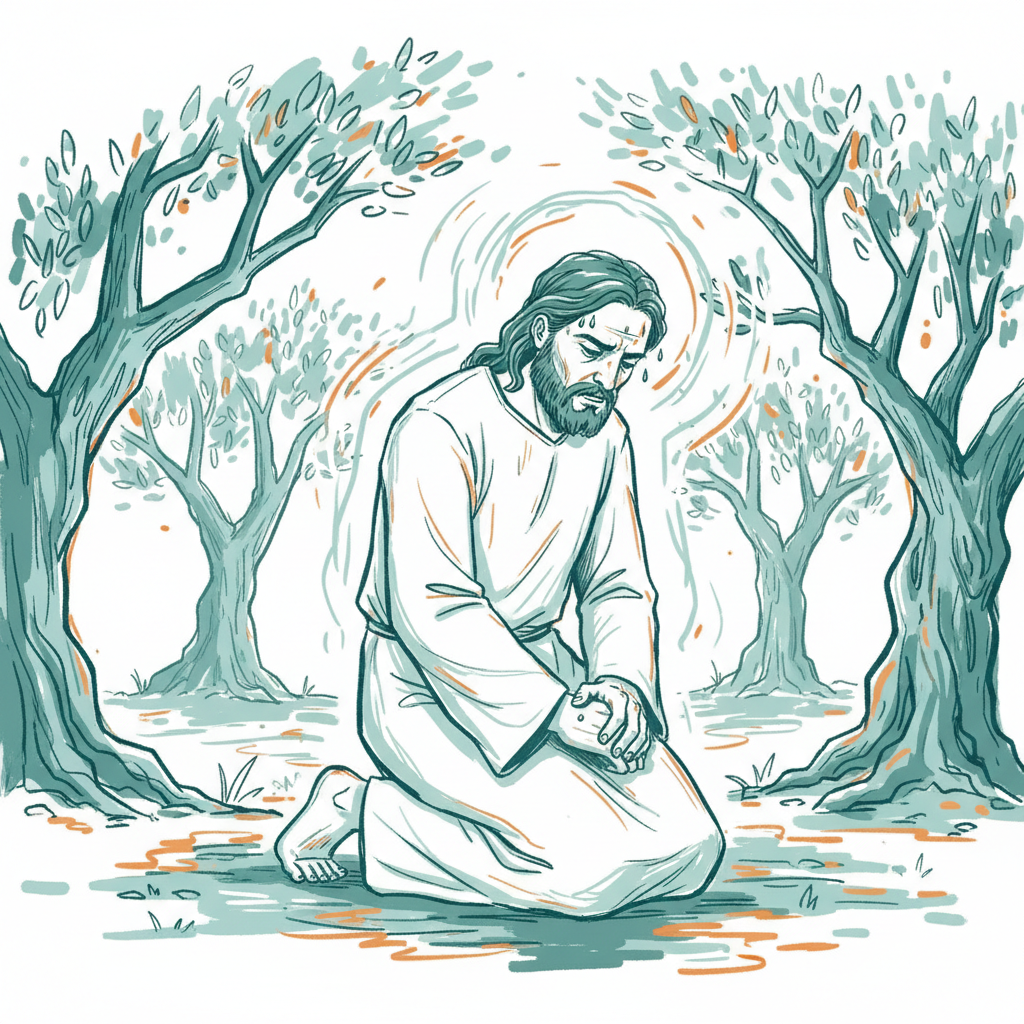
I pictured grief. A man weeping. Maybe the way you weep when you know something terrible is coming and you can't stop it. That image of Jesus in the garden was soft-focus in my mind. Sad. Heavy. Resigned.
Then I looked up the Greek word, and the whole scene changed.
The Word Nobody Expects
Luke 22:44 says Jesus was "in agony." Most of us absorb that word and keep moving. Agony means pain. Suffering. Right? In English, yes. In Greek, the word is agōnia (ἀγωνία), and it does not come from the vocabulary of pain. It comes from the arena.
Agōnia is derived from agōn, the Greek word for an athletic contest. A wrestling match. A struggle for victory. When the ancient world heard agōnia, they pictured a wrestler locked body-to-body with an opponent, every muscle engaged, looking for the leverage that would decide the outcome. They pictured a runner at the ragged end of a race, legs failing, lungs burning, choosing to keep going because the finish line was close enough to see.
Agōnia is derived from agōn, the Greek word for an athletic contest. A wrestling match. A struggle for victory.
This word appears exactly once in the entire New Testament. Luke used it here and nowhere else. And Luke was particular. He was a physician who paid attention to detail. He chose agōnia because it described what he understood was happening. Jesus was not passively suffering in that garden. He was actively contesting something. Something was being decided. And the decision required a fight.
Jesus was not passively suffering in that garden. He was actively contesting something. Something was being decided. And the decision required a fight.
Agony, struggle, contest
ἀγωνία
agōnia · G0746
This Greek word, used to describe Jesus' state in Gethsemane, comes from the athletic arena, not the vocabulary of pain. It signifies an intense, focused struggle for victory.
What Was Being Fought?
The Gospels pull the curtain back on the contest. Jesus prayed: "Father, if you are willing, remove this cup from me" (Luke 22:42). That cup, in the prophetic tradition of Israel, is the cup of God's wrath. Isaiah 51:17 describes Jerusalem drinking it. Jeremiah 25:15 describes God extending it to the nations. The cup is judgment. And Jesus was asking whether there existed any other mechanism in the universe by which that judgment could be satisfied without Him drinking it.
The answer was no. And I don't think Jesus was surprised by the answer. But He asked honestly, out of a genuine human desire for another way, because that's what real incarnation looks like. A real human body. A real human will. A real human voice saying, "Is there another option?"
And then the word that changes everything: "Nevertheless." Some translations say "yet." Luke says plēn, a Greek word that functions like a hard pivot. Everything before plēn is honest human grief. Everything after plēn is divine resolve. "Nevertheless, not my will, but yours be done."
That's not the sound of someone giving up. I misread it for years. That's the sound of someone winning. The agōn is over. The contest between a human will that wanted relief and a divine purpose that required the cross has been resolved. Not by force. By choice. And the choice cost everything the body had.
That's not the sound of someone giving up. I misread it for years. That's the sound of someone winning.
Nevertheless, except, but
πλήν
plēn · G4133
Luke's use of plēn acts as a powerful pivot, shifting from Jesus' honest human desire for relief to His divine resolve to fulfill God's will.
Why the Private Battle Matters More Than the Public One
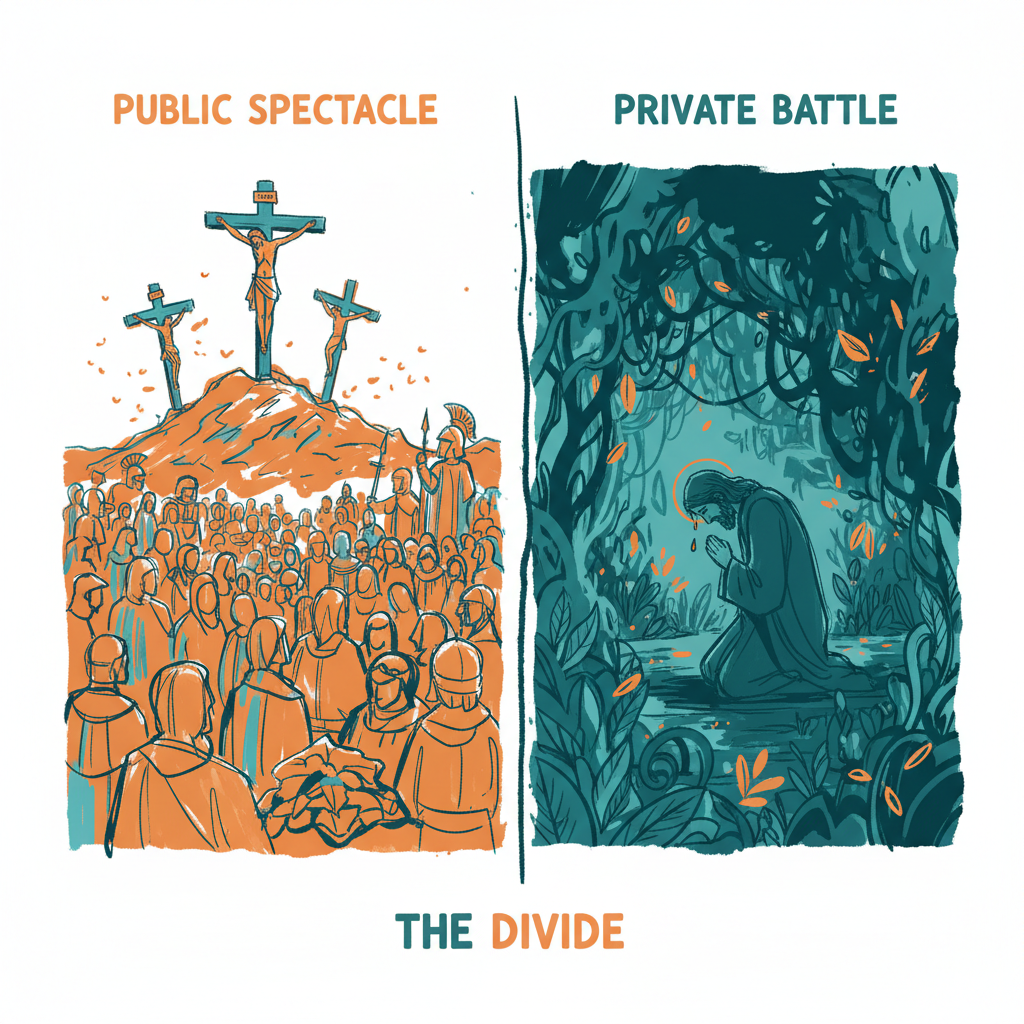
The cross was spectacle. Roman crucifixion was engineered for visibility. Elevated. Public. Crowds, soldiers, mockery, a sign nailed above His head for anyone literate to read. Everything about Golgotha was designed to be seen.
The garden was the opposite. Night. Privacy. Three friends who were supposed to watch but couldn't keep their eyes open. Jesus returned from prayer three times to find Peter, James, and John sleeping. "Could you not watch with me one hour?" (Matthew 26:40). They couldn't. The most important decision in human history was made in complete solitude.
This tells us something about obedience that we'd rather not hear. The hardest decisions are almost never made in front of an audience. They're made at 2 AM when nobody knows. They're made in the dark, when the easier path is right there and no one would know if you took it. The victory in the garden was won without spectators, without applause, without anyone standing close enough to say, "I saw what you did, and it mattered."
The hardest decisions are almost never made in front of an audience. They're made at 2 AM when nobody knows.
Friday gets the sermons. Thursday night deserves them more.
The Body Under Pressure
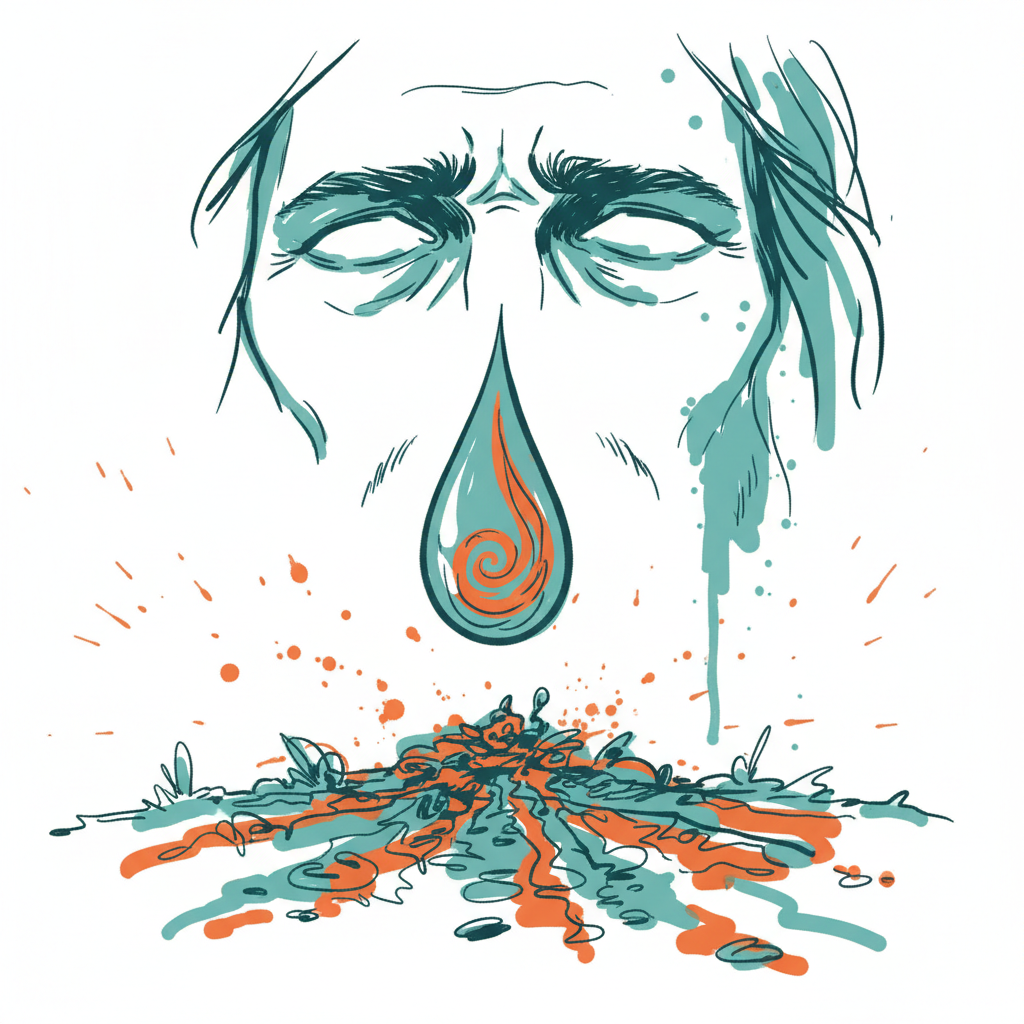
Luke, the physician, noticed something the other Gospel writers didn't record. "His sweat became like great drops of blood, falling down to the ground" (Luke 22:44). The Greek uses hōsei, a comparison word. Whether Jesus experienced literal hematidrosis, a rare condition in which capillaries near the sweat glands rupture under extreme psychological stress, or whether Luke was describing the sheer intensity of the sweat in vivid terms, the point is the same. The contest registered in the body. The agōnia was not abstract. It was physical.
Medical literature has documented hematidrosis in people facing extreme distress, including patients awaiting execution. The condition is rare but real. And it is striking that the one Gospel writer with medical training is the one who recorded this physical detail. A doctor noticed. A doctor wrote it down.
The incarnation means that the decision in the garden cost Jesus something measurable. Something that left marks. The will was surrendered, and the body showed the price.
The Agōn Family in the New Testament
Though agōnia appears only once, its root agōn appears in several significant passages. Hebrews 12:1 calls the life of faith an agōna, a race to be run with endurance. Paul tells Timothy to "fight the good fight" (1 Timothy 6:12), using the same word. Philippians 1:30 speaks of the same "struggle" Paul and the Philippians share. In every case, agōn describes active, engaged, costly endurance. Not endurance that sits and absorbs. Endurance that fights forward.
When Luke applied agōnia to Jesus, he was placing Gethsemane in the tradition of every faithful struggle that came before and every one that would come after. And he was saying that the founder of the faith fought harder than anyone.
A contest, struggle, race
ἀγών
agōn · G0073
The root of agōnia, agōn, refers to an athletic competition, like a wrestling match or a race. It implies active, engaged, and costly endurance, not passive suffering.
For the Person in Their Own Garden
If you've ever prayed the same prayer three times and heard the same silence, you know something about Gethsemane. Maybe not the weight of it. None of us carry that. But the shape of it. The asking and the quiet. The wanting and the waiting.
I won't pretend to know why God sometimes answers a desperate prayer with what feels like nothing. But I know this. Jesus asked three times for the cup to pass, and the cup stayed. And from that unanswered prayer came the answered prayer of every person who has called on His name for two thousand years.
The cross took His life. The garden took His will. And if you asked me which surrender was harder, I'd say the garden. Every time. Because on the cross, the choice was already made. In the garden, it was still being made. And He made it alone.
The cross took His life. The garden took His will. And if you asked me which surrender was harder, I'd say the garden. Every time.
The garden was the arena where the greatest victory was won.
It was a battle of wills, fought in solitude, for the salvation of all.
ἀγωνία
Agōnia
Fight the good fight.