The Last Word: What Jesus Actually Meant by "It Is Finished"
John 19:30 · Greek Word Study
The Last Word: What Jesus Actually Meant by "It Is Finished"
Unpacking the profound meaning of Jesus' final declaration from the cross.
I need to tell you what I got wrong about Good Friday.
For years, when I read John 19:30, I heard a man at the end of His rope. "It is finished." I heard exhaustion. Relief, maybe. The final breath of someone who had endured the worst thing imaginable, and now it was over. I pictured closed eyes and a body going limp and the terrible mercy of it finally being done.
And I wasn't hearing what was actually said.
The word is tetelestai. One word in Greek. Teh-TEL-es-tai. John records it in his Gospel, and he records it carefully, because John is always careful. This is the same writer who spent three chapters on a single conversation with Nicodemus and devoted an entire chapter to Jesus washing feet. John does not waste words. So when he tells you the last thing Jesus said, pay attention to which word he chose.
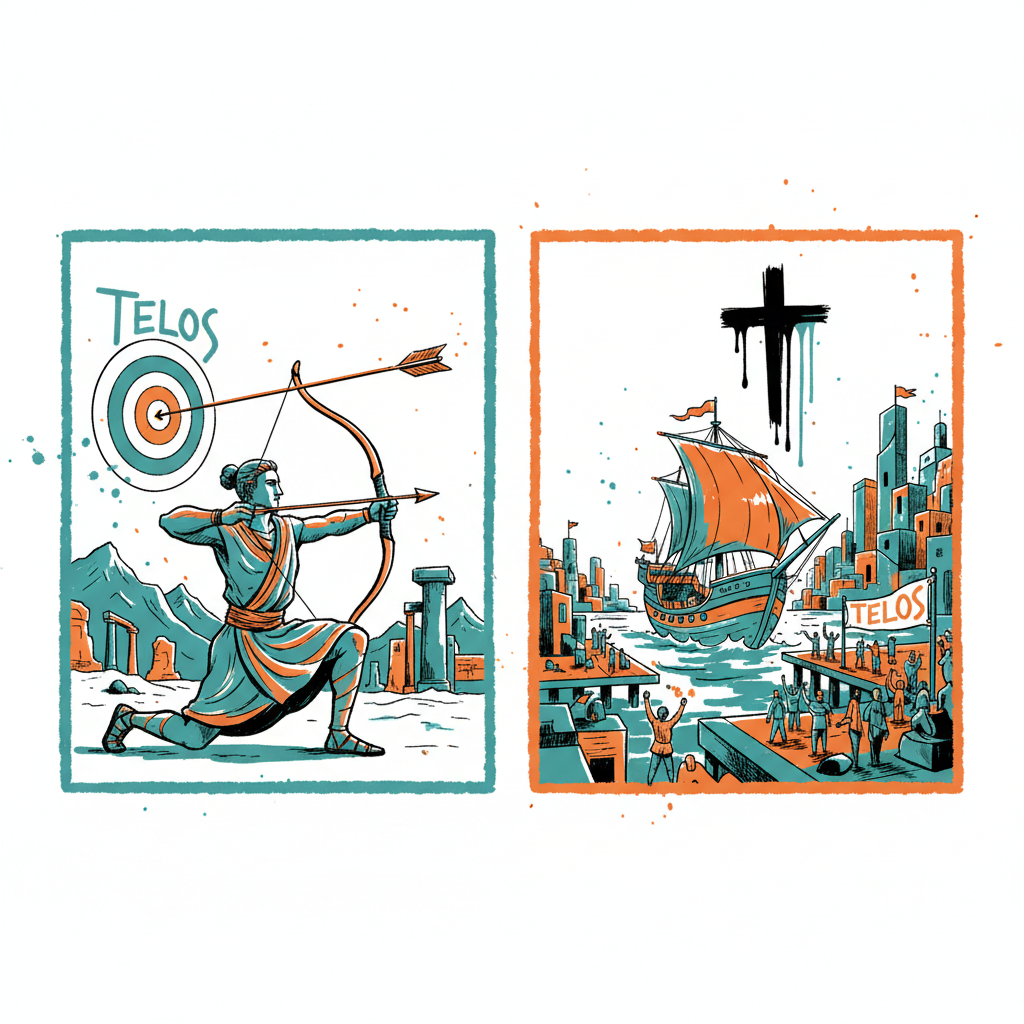
Tetelestai comes from the verb teleō (Strong's G5055). It appears 28 times across the New Testament. And it doesn't mean "stop." It doesn't mean "I'm done." The root is telos, and telos means goal. Destination. The place a thing was always intended to reach.
When an archer's arrow hits the center of the target, that's telos. When a ship reaches the port it sailed toward, that's telos. When a seed becomes the tree it was encoded to become, that's telos.
The root is telos, and telos means goal. Destination. The place a thing was always intended to reach.
So teleō means to bring something to its designed completion. Not just to cease, but to arrive.
And Jesus, from a Roman cross, with a body that was shutting down and lungs that were filling, chose this word. Not "I'm finished." Not "It's over." He said: it has reached where it was going.
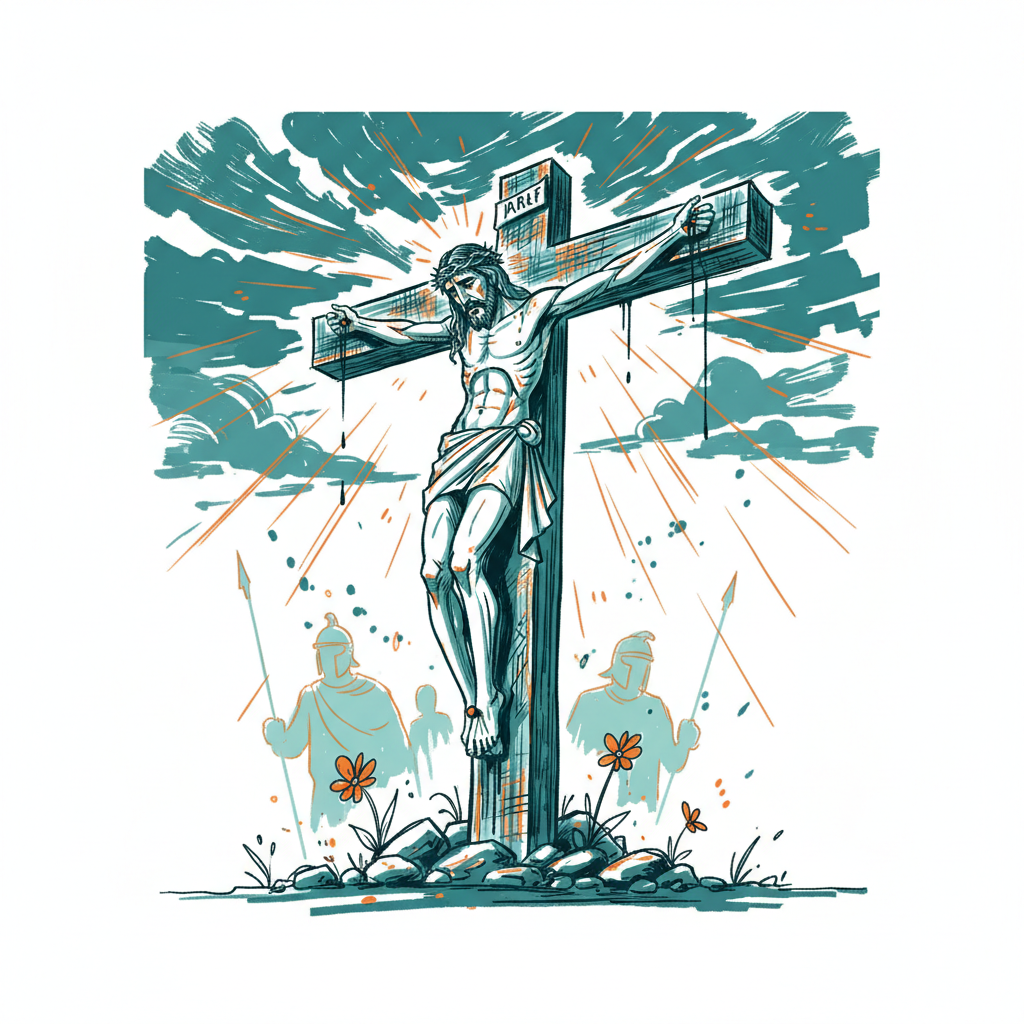
It has been finished, it stands complete
τετέλεσται
tetelestai · G5055
This Greek perfect tense verb signifies an action completed in the past with ongoing, permanent results into the present. It means something has reached its intended goal and remains in that state of completion.
To bring to an end, to complete, to accomplish
τελέω
teleō · G5055
The root verb from which tetelestai is derived. It means to bring something to its designed completion or destination, not merely to stop or cease.
Goal, destination, end
τέλος
telos · G5056
The noun form, meaning the ultimate purpose or destination something was intended to reach. It implies fulfillment and completion, like an arrow hitting its target.
The Verb Tense That Carries the Weight
Here's where this gets personal for me, and honestly, this is the part that rearranged something in my chest the first time I understood it.
Tetelestai is in the Greek perfect tense. If you're not a grammar person, stay with me. This matters more than almost any other grammar point in the New Testament.
In Greek, the perfect tense does something no English tense can do in a single word. It describes an action that was completed in the past and whose results continue, right now, permanently, into the present. It's not past tense. Past tense says "this happened." Perfect tense says "this happened, and the reality it created is still in effect, and it will remain in effect."
In Greek, the perfect tense does something no English tense can do in a single word. It describes an action that was completed in the past and whose results continue, right now, permanently, into the present.
The difference is the difference between "I locked the door" and "the door stands locked." Between "the war ended" and "peace holds."
Daniel Wallace, in his standard reference Greek Grammar Beyond the Basics, describes the perfect tense as communicating "a state of affairs that came about as a result of a completed action." The action is finished. What it produced is not finished. It persists.
So tetelestai doesn't mean "this just ended." It means "this was brought to completion, and the completion holds. Now. Tomorrow. A thousand years from now."
So tetelestai doesn't mean "this just ended." It means "this was brought to completion, and the completion holds. Now. Tomorrow. A thousand years from now."
Wuest's Expanded Translation renders it: "It has been finished and stands complete."
Read that again slowly if you need to. I did.
What John Wanted You to Notice
John does something in verses 28 through 30 of chapter 19 that disappears in English translation but screams in Greek.
Verse 28: "After this, Jesus, knowing that all things were now accomplished [tetelestai], to fulfill [teleiōthē] the Scripture, said, 'I am thirsty.'"
Verse 30: "When Jesus had received the sour wine, He said, 'It is finished [tetelestai].' And He bowed His head and gave up His spirit."
Two words from the same family, placed side by side. Tetelestai (from teleō, "to complete") and teleiōthē (from teleioō, "to fulfill, to bring to perfection"). John sets them next to each other like a poet placing two notes in harmony. The completion of Christ's work and the fulfillment of every Scripture that pointed to this moment are happening simultaneously. Same breath. Same hill. Same afternoon.
Leo the Great caught this in the fourth century. Martin Luther caught it during the Reformation. It's not subtle once you see it. Jesus' work was completed. Scripture's portrait was finished. One moment did both.
The Telos Family
Telos (τέλος) — Goal, destination, purpose
Teleō (τελέω) — To bring to its designed completion
Tetelestai (τετέλεσται) — It has been completed and stands complete (perfect tense)
Teleioō (τελειόω) — To fulfill, to bring to perfection
The Receipt Story (And Why I Stopped Telling It)
I have to be honest about something here, because FaithLabz doesn't get to skip the hard parts.
For years, I repeated a claim that goes something like this: "Tetelestai was stamped on ancient receipts in the first century. It meant 'paid in full.' So when Jesus said 'It is finished,' He was using invoice language."
It's a stunning sermon illustration. I loved telling it. And the evidence behind it has largely crumbled.
Here's what actually happened. In the 1890s, archaeologists found papyrus receipts in the Arsinoites region of Egypt. These were customs tax documents for cargo passing through ports and gates. Many contained the abbreviation "tetel" at the beginning. Early scholars, including the respected Moulton and Milligan in their 1915 Vocabulary of the Greek New Testament, assumed this abbreviated tetelestai and suggested it carried a meaning of debts discharged.
The problem surfaced later. On the receipts where the scribes didn't abbreviate and actually spelled out the full word, it wasn't tetelestai. It was tetelōnētai. A completely different Greek word, derived from telōnēs, "tax collector." It means "the tax has been paid." Not "debt paid in full." These were tax receipts. For things like a man named Nepheros exporting two baskets of dates on a donkey through an Egyptian gate. That's what the receipts recorded.
By 1934, official papyrus databases had corrected the reading. But the sermon illustration had taken on a life of its own, and it's still circulating on Christian social media every Easter.
Gary Manning Jr., Professor of New Testament at Biola University, examined the evidence directly in 2022 and found that the supposed meaning "paid in full" for tetelestai does not appear in any other ancient Greek sources. Not in literary works, not in papyri, not in inscriptions. Anywhere.
So let me be clear about what FaithLabz IS and IS NOT saying here. We are NOT saying the theology of Jesus paying for sin is wrong. That doctrine is bedrock, and it doesn't depend on tetelestai at all. Mark 10:45 calls His death a "ransom." First Peter 1:18-19 says we were redeemed with "the precious blood of Christ." Colossians 2:14 says the "certificate of debt" was nailed to the cross. The payment theology stands on its own two feet across dozens of passages.
What we ARE saying is that tetelestai itself carries a different, and in some ways deeper, meaning. Not a financial transaction completed. A cosmic mission arrived at its destination. An entire plan, stretching from Eden to Golgotha, reaching the exact place it was always meant to reach.
A receipt tells you a bill was settled. Tetelestai tells you everything God set in motion from the beginning of the world has come home.
A cosmic mission arrived at its destination. An entire plan, stretching from Eden to Golgotha, reaching the exact place it was always meant to reach.
I'll take that trade.
The tax has been paid
τετελώνηται
tetelōnētai · N/A
A different Greek word found on ancient tax receipts, derived from 'telōnēs' (tax collector). It means a tax has been paid, not 'debt paid in full' in a broader sense.
What Was Finished
If tetelestai means "brought to its intended goal," the question that matters is: what goal?
Start with the sacrificial system. For over a thousand years, Israel offered animal sacrifices that covered sin temporarily. Hebrews 10:4 is blunt about the limitation: "It is impossible for the blood of bulls and goats to take away sins." Every lamb, every goat, every burnt offering was a finger pointing forward. Saying: not me, but Someone is coming. On that Friday afternoon, the Someone arrived. The temporary pointing gave way to the permanent reality. Tetelestai. The system reached its telos.
Then the prophecies. Isaiah 53 painted a portrait of a suffering servant, pierced for our transgressions, crushed for our iniquities. Psalm 22 described a man whose hands and feet were pierced, whose garments were divided by lot, who cried out "My God, my God, why have you forsaken me?" Zechariah 12:10 spoke of one whom they would pierce, and mourn for. John's Gospel methodically records these fulfillments in Jesus' final hours, one after another after another, like a checklist being completed in real time. When Jesus says tetelestai, every line of that centuries-old portrait has been filled in. The picture is complete.
And then there's the Father's assignment. Earlier, in John 17:4, Jesus had prayed: "I have glorified you on earth, having accomplished the work that you gave me to do." Tetelestai is the final word on that prayer. The Son reporting to the Father: the work You gave Me has reached the place You sent it. Nothing left undone. Nothing left to add.
Prophecies Fulfilled
Isaiah 53 — Suffering servant, pierced for our transgressions
Psalm 22 — Hands and feet pierced, garments divided, cry of abandonment
Zechariah 12:10 — One whom they would pierce and mourn for
Three in the Afternoon on a Friday
Let me put you there for a moment.
It's roughly the ninth hour. Three in the afternoon. The sky has been dark since noon, which is not how skies work, and everyone knows it. A man who was walking and teaching and breaking bread with friends less than 24 hours ago is hanging between two criminals on a hill that locals call "The Skull." He has been beaten. Scourged. A crown of thorns pressed into His scalp. Nails through His wrists and feet. He's been hanging for six hours.
Crucifixion kills by asphyxiation. The weight of the body pulls the arms out of socket and collapses the lungs. To breathe, you have to push yourself up on the nails in your feet, hold yourself there long enough to exhale and inhale, then sag back down. Every breath is a decision to endure more pain.
And in one of those breaths, He doesn't cry out in agony. He doesn't beg for it to stop. He pushes Himself up one final time and speaks.
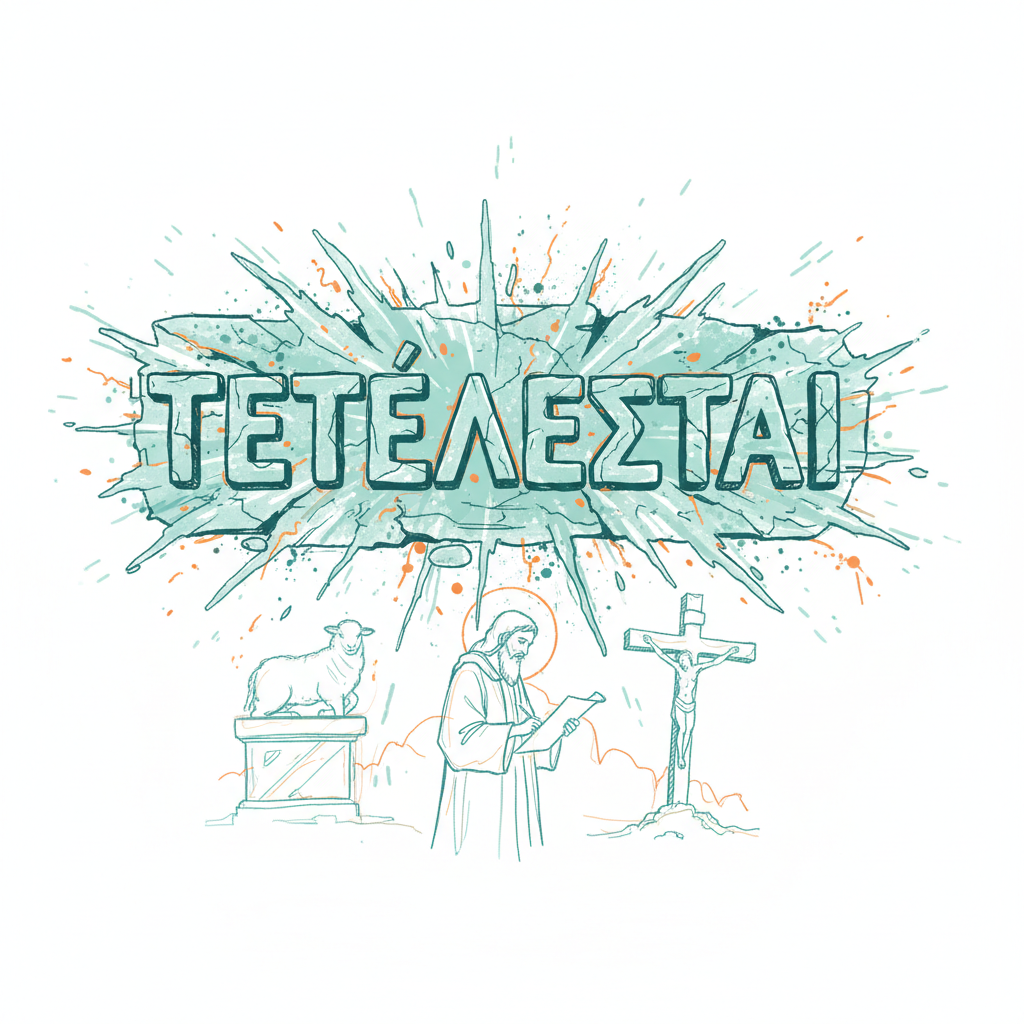
Tetelestai.
It has reached its intended goal, and it stays there.
Then John adds six words that should stop you: "He bowed His head and gave up His spirit." Not "His spirit left Him." Not "He died." He gave it up. Voluntary. Deliberate. Even the act of dying was something He did, not something done to Him.
He gave it up. Voluntary. Deliberate. Even the act of dying was something He did, not something done to Him.
The man who could call down twelve legions of angels chose to push up on pierced feet one last time. Not to scream. Not to plead. To file the final report.
Mission complete. Completion holds.
What This Means for Thursday Night
Tomorrow is Good Friday. You'll hear this story again. Maybe at a service. Maybe in a quiet moment alone. And when you get to the part where He says "It is finished," you'll know now what the word actually carries.
It's not a sigh of relief. It's a declaration of arrival. A verb tense that refuses to expire. Whatever the Father set in motion when He promised Eve that her offspring would crush the serpent's head, whatever Isaiah saw when he wrote about the one who would bear our griefs and carry our sorrows, whatever every Passover lamb ever pointed to when its blood was painted on a doorframe... it reached the place it was going. On a hill. On a Friday. In one word.
And the perfect tense means it's still reaching you right now.
Whatever you're carrying tonight. Whatever feels unfinished, unpaid, unresolved. There is a word spoken from a cross 2,000 years ago, in a verb tense that means it never stops being complete.
Tetelestai.
It holds.
Whatever you're carrying tonight. Whatever feels unfinished, unpaid, unresolved. There is a word spoken from a cross 2,000 years ago, in a verb tense that means it never stops being complete.
It holds.
τετέλεσται
Tetelestai
Walk out in His finished work.