Why Paul Called Death the Last Enemy (1 Cor 15:26)
1 Corinthians 15 · Word Study · Theology
The Last Enemy: Why Paul Put Death at the End of the List
Unpacking Paul's profound insight: Death is not just a fact, but the ultimate foe defeated by Christ.
I used to think the worst thing was the sin. Or the devil. The big, obvious villains of the Bible.
Then I sat in a hospital room with a friend who had three weeks left. He wasn't wrestling with temptation. He wasn't thinking about spiritual warfare. He was watching the clock and counting breaths. And I realized something Paul apparently knew two thousand years before me. Death is the final enemy. Not because it's the most dramatic, but because it's the one every other enemy serves.
Death is the final enemy. Not because it's the most dramatic, but because it's the one every other enemy serves.

The Word Paul Used
The Greek word for death in the New Testament is thanatos. It appears roughly 120 times across the New Testament texts, and it comes from the verb thnesko, which simply means "to die." But what's remarkable isn't the etymology. It's how the New Testament writers treated the word.
They didn't use thanatos the way we use "death" in casual English. We say "death" like a fact. A medical status. A line on a certificate. Paul used thanatos like a title. He personified it. He talked to it. In 1 Corinthians 15:55, he looks death in the face and asks, "O death, where is your sting?" That's not a rhetorical question aimed at a concept. That's a taunt aimed at a defeated opponent.
Paul used thanatos like a title. He personified it. He talked to it.
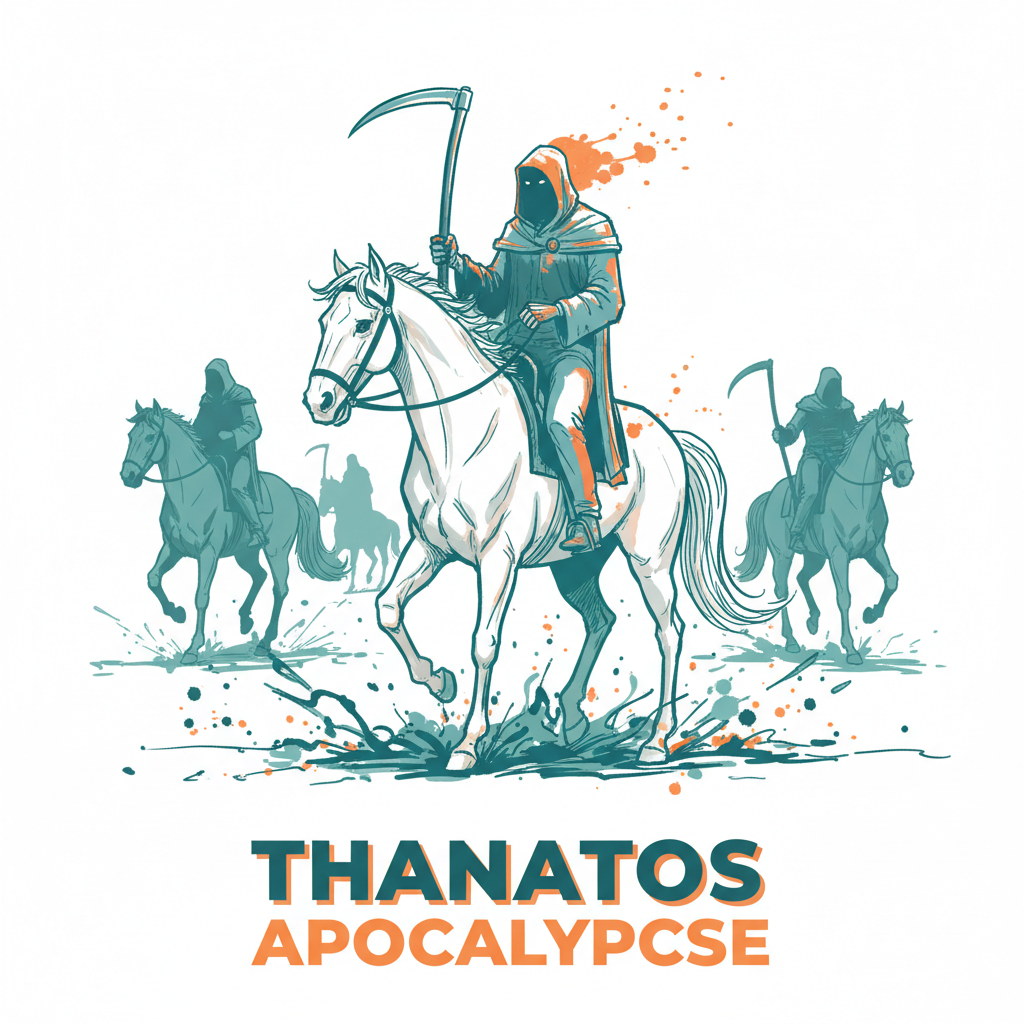
And he's not the only one. In Revelation 6:8, the fourth horseman rides a pale horse, and the text names him. Not Conquest. Not War. Not Famine. Only the fourth horseman gets a name in the Greek: Thanatos. Death rides named while the others remain anonymous.
Death rides named while the others remain anonymous.
death
θάνατος
thanatos · G2288
This Greek word for death is used throughout the New Testament, often personified as a powerful enemy rather than a mere biological event.
to die
θνήσκω
thnesko · G2348
The root verb from which 'thanatos' is derived, simply meaning 'to die.' The noun form, however, takes on a much deeper, more adversarial meaning in Paul's writings.
The Ranking Nobody Talks About
In 1 Corinthians 15, Paul lays out what happens when Christ's resurrection reaches its full effect. Verses 24 through 26 describe a sequence: "Then comes the end, when he delivers the kingdom to God the Father after destroying every rule and every authority and power. For he must reign until he has put all his enemies under his feet. The last enemy to be destroyed is death."
Notice the order. Rules. Authorities. Powers. Then, at the very end: death. Paul calls death the eschatos echthros. The last enemy.
Not sin. Sin entered the story in Genesis 3, and it's devastating, but Paul doesn't position it at the end of the line. Not Satan. Hebrews 2:14 tells us that Christ's death was designed to "destroy the one who holds the power of death, that is, the devil." Satan wields death like a weapon, but the weapon itself is what Paul puts in the final slot.
Satan wields death like a weapon, but the weapon itself is what Paul puts in the final slot.
Think about why that matters. Sin is the disease that makes death possible. Satan is the figure who exploits death's power. But death is the thing every other enemy ultimately delivers you to. The wages of sin isn't shame. It isn't struggle. "The wages of sin is death" (Romans 6:23). Every road ends at the same door. And Paul says that door is the last one Christ kicks open.
last enemy
ἔσχατος ἐχθρός
eschatos echthros · G2078 G2190
Paul's powerful phrase to describe death's ultimate position in the hierarchy of opposition to God, signifying it as the final foe Christ must conquer.
The Greek Mythology Connection
Here's something most Bible readers don't know. In the ancient Greek world Paul inhabited, Thanatos wasn't just a word. He was a figure. In Greek mythology, Thanatos was the personification of death, the son of Nyx (Night) and the twin brother of Hypnos (Sleep).
That twin connection is worth sitting with for a moment. The Greeks saw death and sleep as brothers. They look alike. They feel alike. Both involve closing your eyes and going still. But one you wake up from. And the other, in the Greek understanding, you don't.
Now read 1 Thessalonians 4:13, where Paul says he doesn't want believers to grieve like people "who have no hope" about those who have "fallen asleep." The Greek word for "fallen asleep" there is koimao. Paul is borrowing the twin metaphor. He's saying: for the believer in Christ, death isn't the twin who keeps you. It's the twin who looks like sleep. Because you will wake up.
to fall asleep
κοιμάω
koimao · G2837
Used by Paul to describe the death of believers, drawing a direct parallel to the Greek mythological twin of Thanatos (Death), Hypnos (Sleep), signifying a temporary state from which one will awaken.
What the Resurrection Claims
So when Easter Sunday makes its annual claim, let's be precise about what's being said. The claim is not merely that a good man survived an execution. The claim is that the eschatos echthros, the last and ultimate enemy, the one every other evil in the cosmos serves, was defeated. Not negotiated with. Not managed. Defeated.
The claim is that the eschatos echthros, the last and ultimate enemy, the one every other evil in the cosmos serves, was defeated. Not negotiated with. Not managed. Defeated.
Paul stacks four power words in Ephesians 1:19-20 to describe the force it took: dunamis (power), energeia (working), kratos (might), ischus (strength). Four words because one wasn't enough. The resurrection required a concentration of divine power unlike anything else in Scripture. Because the enemy it faced was unlike any other enemy.
And notice: Paul says this same power is now at work in you (Ephesians 1:19). The energy required to defeat the last enemy didn't get shelved after Easter morning. It's operational. It's present tense.
power, working, might, strength
δύναμις, ἐνέργεια, κράτος, ἰσχύς
dunamis, energeia, kratos, ischus · G1411, G1753, G2904, G2479
These four distinct Greek words are stacked by Paul to convey the immense, concentrated divine power required for Christ's resurrection and the defeat of the last enemy.
Why This Matters at 2 AM
Theology sounds impressive in a classroom. It sounds different in an ICU waiting room.
When someone you love is dying, you don't need a lecture on Greek verb tenses. You need to know whether the thing taking them is the final word or not. Paul's answer is specific. Death is an enemy. A real one. The last one. And it has already been engaged by a power greater than itself.
That doesn't make grief lighter. It doesn't answer every question. But it does this: it puts death in its place. Not as the final chapter, but as the final enemy. And according to Paul, enemies can be defeated.
The risen Christ has a track record of doing exactly that.
Death is an enemy. A real one. The last one. And it has already been engaged by a power greater than itself.
The risen Christ has a track record of doing exactly that.
Ἀνάστασις
Anástasis
Rise above the final enemy.