NOV 28 | The Gospel of Leftovers: What the Twelve Baskets Really Mean
Have you ever noticed that the miracle of feeding the five thousand doesn't actually end when everyone's fed?
Most of us grew up hearing this story as a lesson about Jesus's power—a boy's lunch becomes a feast for thousands. Miracle complete. Story over. But if you stop there, you miss something extraordinary hiding in plain sight.
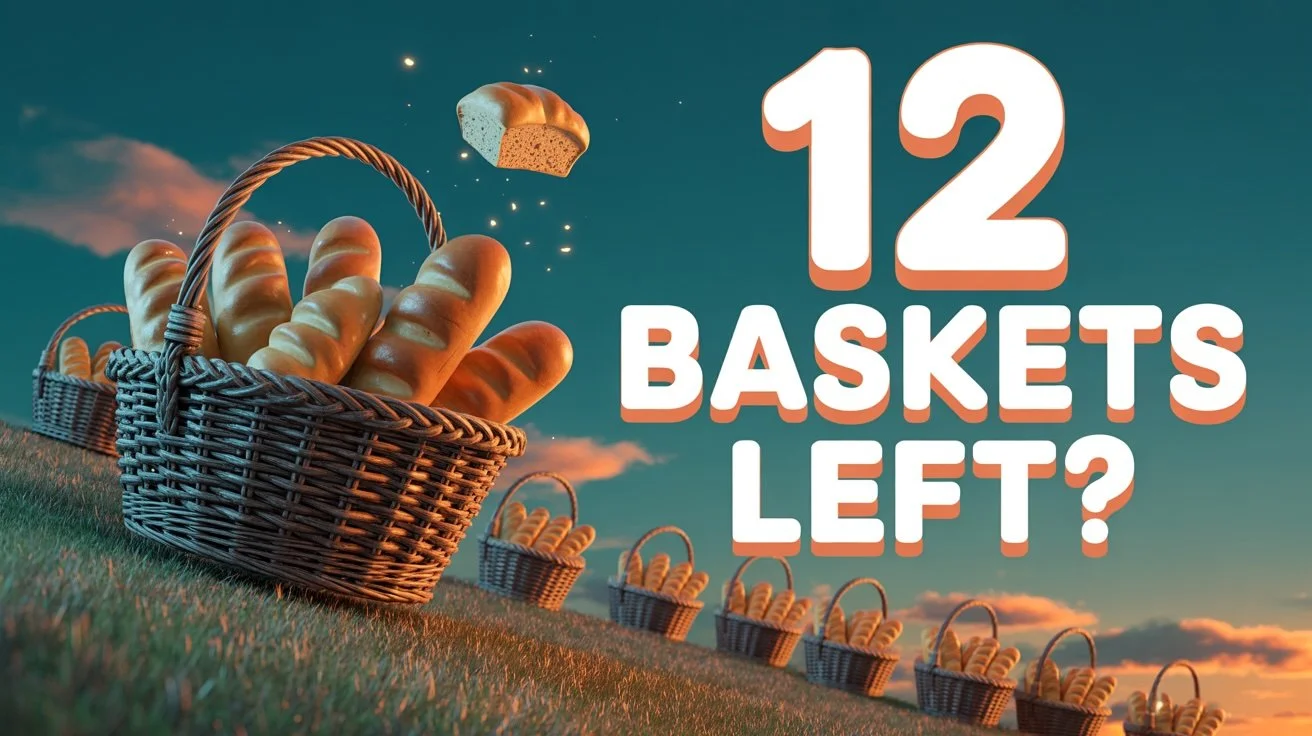
After the crowds are satisfied, after five thousand men plus women and children have eaten their fill, Jesus gives his disciples a strange instruction: gather up the leftovers. And when they do, they collect exactly twelve baskets full.
Not eleven. Not thirteen. Twelve.
That number isn't random. And what it reveals about God's economy, his heart for broken things, and his abundance that never runs out might just change how you see your own life—especially the parts you've written off as waste.
The Overlooked Ending to a Famous Miracle
The feeding of the five thousand holds a unique place in Scripture. It's the only miracle, apart from the resurrection itself, that appears in all four Gospels. Matthew, Mark, Luke, and John all thought this moment was too important to skip.
But here's what fascinates me: John lingers on a detail the other Gospel writers mention only briefly. In John 6:12-13, we read:
"When they had all had enough to eat, he said to his disciples, 'Gather up the leftover fragments, that nothing may be lost.' So they gathered them and filled twelve baskets with the pieces of the five barley loaves left over by those who had eaten."
Jesus didn't say, "Clean up after yourselves" or "Don't be wasteful." He said gather them up so that nothing may be lost.
That word "lost" in Greek is apollymi. It's the same word John uses later in his Gospel when Jesus says, "I have not lost one of those you gave me." This isn't about food storage. Jesus is making a theological statement embedded in a practical instruction.
The leftovers matter. The fragments matter. Nothing—and no one—is meant to be discarded.
God's Economy Works Differently Than Ours
Here's the thing about how most of us think about resources: we operate in scarcity mode.
There's only so much to go around. If I give, I'll have less. If I share what little I have, I might end up with nothing. We hoard because we're afraid. We hold back because the math doesn't seem to work any other way.
But Jesus operates in a completely different economy.
A young boy shows up with five barley loaves and two small fish. It's barely enough for his own lunch, let alone a crowd of thousands. Yet when this meager offering passes through Jesus's hands, it doesn't just stretch to meet the need—it multiplies beyond it.
Five loaves become enough for five thousand, with twelve baskets left over.
This is the economy of the Kingdom: giving doesn't diminish you; it multiplies through you. Offering what seems insignificant doesn't leave you empty; it leaves you carrying more than you brought.
Think about that for a moment. The disciples started with almost nothing. They ended the day each carrying a basket full of bread. Twelve disciples. Twelve baskets. Each one walked away with more than they came with.
Why Twelve Baskets? The Number Isn't Coincidence
Numbers matter in Scripture. They carry meaning. And twelve is one of the most significant numbers in the entire biblical narrative.
Twelve tribes of Israel. Twelve disciples. Twelve gates in the New Jerusalem. Twelve foundations. Twelve apostles of the Lamb.
When Jesus feeds five thousand people and the leftovers fill exactly twelve baskets, he's not just performing a miracle of multiplication. He's making a statement about restoration and completeness.
Israel's twelve tribes represented the fullness of God's covenant people. By the first century, ten of those tribes had been scattered and seemingly lost to history. But here's Jesus, standing on a hillside, demonstrating that in his Kingdom nothing is lost. The twelve baskets signal wholeness, restoration, and the gathering of what was scattered.
Every disciple carried a basket home that day. Each one held physical proof that when you bring what little you have to Jesus, you don't walk away empty-handed. You walk away with overflow.
"That Nothing May Be Lost"
This phrase haunts me in the best possible way.
Jesus could have said gather the leftovers so they won't go to waste. That would make practical sense. But he chose different language. He said gather them so that nothing may be lost.
Lost sheep. Lost coins. Lost sons.
Throughout Luke 15, Jesus tells three parables about lost things that are sought, found, and celebrated. The shepherd leaves ninety-nine sheep to find the one that wandered off. The woman lights a lamp and sweeps her house searching for a single coin. The father runs down the road to embrace the son who'd squandered everything.
God is in the business of gathering fragments.
When Jesus instructs his disciples to collect the leftover pieces of bread, he's revealing something about his entire mission. He came for the broken pieces. The overlooked scraps. The parts of our lives we've dismissed as too far gone, too insignificant, too damaged to matter.
Nothing is disposable in God's economy. No one is written off. The fragments get gathered.
What This Means for the Day After Thanksgiving
If you're reading this around Thanksgiving—or any time you're surrounded by actual leftovers—there's something beautifully concrete about this passage.
We know what leftovers feel like. They're what remains after the main event. The turkey that gets repackaged. The pie that nobody finished. The dishes that need washing after the guests leave.
Leftovers can feel anticlimactic. The celebration is over. Now comes the cleanup.
But Jesus reframes leftovers entirely. In his hands, what remains after everyone's been served isn't waste—it's abundance. It's proof that there was more than enough. It's provision for tomorrow stored up from today's miracle.
Maybe you feel like a leftover yourself sometimes. Like the main event of your life has passed. Like you're what remains after everyone else got what they needed.
Jesus says: gather those pieces. Nothing is lost. In my economy, fragments become feasts.
The Bread of Life Connection
John places this miracle strategically in his Gospel. Immediately after the feeding of the five thousand, Jesus delivers one of his most famous declarations: "I am the bread of life. Whoever comes to me will never go hungry, and whoever believes in me will never be thirsty" (John 6:35).
The multiplication of loaves wasn't just a miracle to solve a logistical problem. It was a preview. A physical demonstration of a spiritual reality.
Jesus is the bread. He's the one who satisfies completely. And just like the bread that fed thousands with baskets left over, his grace never runs out. His mercy doesn't deplete. His presence doesn't diminish no matter how many people draw from it.
You can't exhaust Jesus. You can't use him up. There's always more—twelve baskets more, always.
This is staggering news for anyone who's ever felt like they've used up their chances. Like they've asked for too much grace. Like surely by now God must be tired of their failures, their doubts, their repeated stumbles.
The leftovers say otherwise. After everyone has taken what they need, there's still overflow. There's always overflow.
Bringing Your Fragments to Jesus
So here's the question that lingers after studying this passage: What fragments are you ignoring?
What broken pieces of your life have you written off as waste? What dreams have you abandoned? What relationships have you stopped hoping could be restored? What parts of yourself have you dismissed as too damaged, too ordinary, too insignificant to offer?
Jesus tells his disciples: gather them up.
Not because he's frugal. Not because waste bothers him. But because in his hands, every fragment has potential. Every leftover can become provision. Every broken piece can fill a basket.
Maybe it's time to stop stepping over the scraps of your life and start gathering them instead.
That half-finished project you abandoned. That friendship that fractured. That calling you talked yourself out of. That part of your story you've tried to forget.
Bring them to Jesus. Let him do the math. His economy doesn't work like ours.
Practical Takeaways
As you move through this week, consider these reflection points:
Examine your scarcity thinking. Where are you holding back from giving because you're afraid of running out? The disciples had almost nothing, yet they ended with abundance. What might multiplication look like in your life if you opened your hands?
Identify your fragments. What pieces of your life have you dismissed as worthless leftovers? A skill you stopped developing? A relationship you gave up on? A dream you buried? Name them specifically.
Trust the gathering. Jesus didn't abandon the fragments to be trampled. He sent his disciples to collect every piece. What would it look like to trust that he's doing the same with the broken parts of your story?
Remember the twelve baskets. When anxiety whispers that there won't be enough—enough grace, enough provision, enough second chances—remember the math of the Kingdom. Five loaves became twelve baskets of overflow. There's always more with Jesus.
Nothing Is Lost
The Gospel of the leftovers is simply this: what remains after the miracle is itself a miracle.
The fragments aren't trash. They're treasure. The scraps aren't waste. They're evidence of abundance. The pieces you thought were worthless? In the hands of Jesus, they fill baskets.
Twelve of them.
Whatever you're carrying today—whatever broken pieces, whatever leftover dreams, whatever fragmented hopes—know this: Jesus is still in the business of gathering. He's still multiplying what's offered to him. He's still filling baskets with what others would throw away.
Nothing is lost. Not the fragments. Not the leftovers.
And not you.
What fragments of your life might need gathering? Share your thoughts in the comments below.

An Invitation to go Deeper….
If today’s message spoke to you, join the FaithLabz 30-Day Prayer Challenge and strengthen your connection with God’s unshakable love. You are never alone—let’s grow together!