DEC 9| The Two Most Powerful Words in Scripture: Understanding "But God" in Ephesians 2:4-5
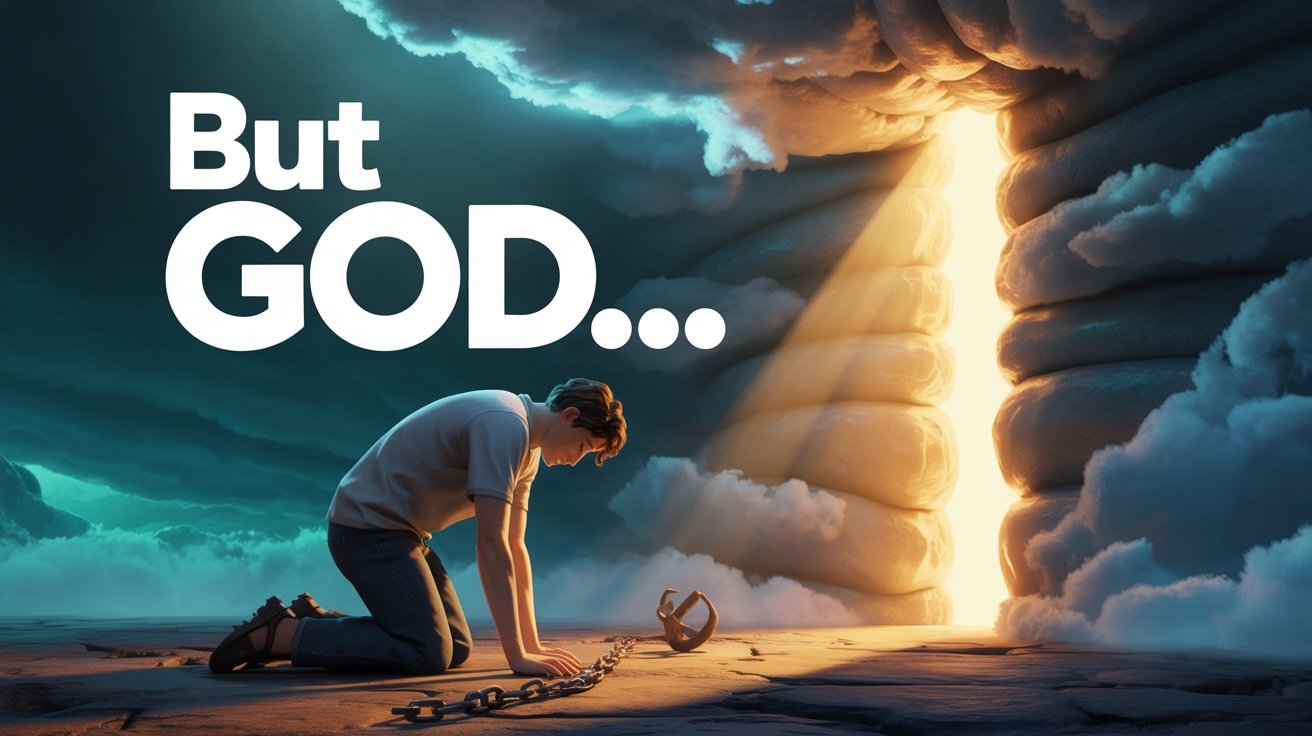
When Everything Changes in Two Words
Have you ever noticed how two simple words can completely change the trajectory of a sentence—and a life? In the English language, we have phrases that serve as pivots, turning points that redirect everything that follows. But perhaps nowhere are two words more powerful, more life-altering, and more hope-filled than when they appear in Scripture.
"But God."
These two words have saved more lives, rescued more marriages, pulled more people back from the brink of despair, and rewritten more hopeless endings than any self-help book, motivational speech, or therapeutic intervention ever could. They represent the divine interruption—the moment when heaven breaks into human hopelessness and flips the script entirely.
In Ephesians 2:4-5, the Apostle Paul delivers what might be the most dramatic "But God" moment in all of his letters. And understanding what he wrote—and why he wrote it—could fundamentally change how you see your own story today.
The Dark Diagnosis: What Comes Before "But God"
Before we can fully appreciate the power of divine interruption, we need to understand what Paul says in the verses leading up to this moment. Ephesians 2:1-3 reads like a spiritual diagnosis, and honestly, it's not encouraging if you stop there.
Paul describes humanity as "dead in transgressions and sins." He talks about following "the ways of this world" and gratifying "the cravings of our flesh." He even uses the phrase "objects of wrath"—language that sounds harsh to modern ears.
Here's what's important to understand: Paul isn't writing this to make his readers feel terrible about themselves. He's establishing a baseline of honesty. He's acknowledging what everyone instinctively knows but rarely admits—that something is fundamentally broken in the human condition that we cannot fix ourselves.
Think about it this way. If you go to the doctor and they tell you everything is fine when it isn't, that's not kindness. That's malpractice. A good doctor tells you the truth about your condition precisely because they have a treatment plan ready.
Paul's dark diagnosis in verses 1-3 sets up the most dramatic reversal in the letter. The bad news makes the good news actually good.
Understanding the Historical Context: Why This Mattered in Ephesus
To fully grasp what Paul is communicating, we need to step back into first-century Ephesus. This wasn't some sleepy religious backwater. Ephesus was home to the Temple of Artemis—one of the Seven Wonders of the Ancient World. The city's economy, culture, and identity were wrapped up in this massive religious institution.
The prevailing worldview in Ephesus, like most of the ancient world, operated on a transactional religious model. Your standing with the gods depended entirely on what you brought to the table. Sacrifices. Rituals. Performances. Religious observance was essentially a business arrangement—you give the gods what they want, and maybe they'll give you what you need.
Paul, likely writing this letter while chained to a Roman guard in prison around 60 AD, is systematically dismantling this entire framework. He's not offering a better religious transaction. He's announcing that God operates on an entirely different system—one where divine action precedes human response.
This was revolutionary. This was counterintuitive. And for people exhausted by trying to earn divine favor, this was the best news they'd ever heard.
Unpacking the Divine Interruption: Ephesians 2:4-5
Now we arrive at the pivot point. After the bleak assessment of human spiritual condition, Paul writes:
"But because of his great love for us, God, who is rich in mercy, made us alive with Christ even when we were dead in transgressions—it is by grace you have been saved."
Let's break this down phrase by phrase, because every word matters.
"Because of His Great Love"
The Greek phrase Paul uses here is dia tēn pollēn agapēn, and that word pollēn deserves attention. It doesn't simply mean "a lot" in the way we might casually use that phrase. It carries the sense of excessive, abundant, over-the-top lavishness.
Paul is describing a love that isn't measured or calculated. It's not rationed based on merit or performance. It's extravagant—like a parent who can't stop hugging their child even when the kid is squirming to get away.
Many people grew up with a stingy conception of God's love. They learned, implicitly or explicitly, that divine affection was earned through good behavior and lost through failure. That's not what Paul describes here. The love that motivates God's action toward humanity is lavish, excessive, and freely given.
"Rich in Mercy"
Mercy and grace often get confused in theological conversations, but the distinction matters. Here's the simplest way to understand it: Mercy is not getting what you deserve. Grace is getting what you don't deserve. They're related but distinct.
The Greek word for mercy in this passage is eleos, and it carries significant Old Testament weight. In the Septuagint (the Greek translation of the Hebrew Scriptures), eleos often translates the Hebrew word chesed—which refers to God's covenant faithfulness, His loyal love that persists despite human unfaithfulness.
This isn't God reluctantly deciding not to punish humanity. This is God's very nature expressing itself. He is rich in mercy—it's not something He has to work up or manufacture. Mercy flows from who He fundamentally is.
"Made Us Alive with Christ"
Here's where Paul's Greek gets particularly beautiful and theologically profound. The verb he uses is synezōopoiēsen—a compound word that unpacks into something remarkable.
Syn means "together with." Zōopoieō means "to make alive."
Paul is saying that believers weren't just given a second chance. They weren't put on spiritual probation with a warning to do better. They were co-resurrected with Jesus Christ. His resurrection isn't merely a historical event that happened two thousand years ago for Christians to believe in. It's an event they're mystically included in.
When God raised Jesus from the dead, in some mysterious way, He raised you too.
This is the heart of Christian hope. The resurrection isn't just something to celebrate on Easter Sunday. It's the defining reality of every believer's existence. Death has already been interrupted. New life has already begun. The "But God" has already happened.
The "But God" Pattern Throughout Scripture
One of the remarkable things about this phrase is that it appears at crucial turning points throughout the biblical narrative. Paul isn't inventing something new in Ephesians 2. He's highlighting a pattern that runs through the entire story of God's interaction with humanity.
Genesis 50:20 — Joseph's brothers are terrified that he'll take revenge for selling him into slavery. Joseph's response includes one of the most famous "But God" statements in the Bible: "You intended to harm me, but God intended it for good."
Psalm 73 — The psalmist Asaph is spiraling into despair, watching wicked people prosper while the righteous struggle. At his lowest point, he writes: "But God is the strength of my heart and my portion forever."
Acts 13:29-30 — Paul, preaching in Antioch, describes the crucifixion: "They took him down from the cross and laid him in a tomb. But God raised him from the dead."
Do you see the pattern? In every human story where the ending seems certain—tragedy, defeat, death, despair—God writes a plot twist. The "But God" isn't a theological abstraction. It's the shape of reality for everyone who follows Jesus.
Your story has "But God" pages in it. You might not be able to see them yet, but they're there.
What This Means for Your Life Today
Theological truth is only valuable when it touches real life. So what does "But God" mean for you, right now, in whatever situation you're facing?
First, it means your worst chapters don't write your ending. Whatever diagnosis has been spoken over your life—by others, by circumstances, by your own inner voice—it's not the final word. The God who interrupted death itself has a habit of interrupting our despair too.
Second, it means you're not waiting for rescue; rescue has already happened. Paul writes in the past tense: God "made us alive with Christ." For believers, the resurrection isn't a future hope. It's a present reality with future implications. You've already been raised with Christ. The spiritual CPR has already been administered. You're alive.
Third, it means your contribution to your salvation was being dead. This might sound strange, but it's actually liberating. Dead people don't contribute to their own resurrection. The fact that God acted "even when we were dead in transgressions" means our acceptance was never based on our performance. We didn't clean ourselves up enough to be acceptable. We were dead, and God made us alive anyway.
A Practical Exercise for This Week
Here's something tangible to try. Take out a piece of paper or open a notes app on your phone. Write down the honest sentence—the hopeless one. The diagnosis that's been echoing in your mind.
Maybe it's: "I've failed too many times..." Or: "My marriage is falling apart..." Or: "I don't know how I'll survive this..."
Whatever it is, write it down. Be honest. Don't spiritualize it.
Then, underneath that sentence, write two words: But God.
Leave space after that. Don't fill it in. Just let those two words sit there as a declaration that your story isn't finished, that the One who interrupted the finality of death has a habit of interrupting lesser finalities too.
Paul wrote Ephesians from prison, remember. His circumstances weren't fixed. He wasn't writing from a place of comfort and ease. He was writing from chains—but he was writing about freedom. He understood that "But God" doesn't always mean immediate deliverance from difficulty. Sometimes it means divine presence within difficulty and ultimate redemption through difficulty.
You're Part of the Story Now
According to Paul, the resurrection isn't something Christians observe from the outside. Believers have been included in it. The "But God" isn't just in the Bible—it's in you.
Whatever you're facing today, whatever sentence seems to be writing itself in your life, remember that God specializes in divine interruptions. He's been doing it since the beginning. He did it supremely in Christ. And He's still doing it now.
The diagnosis isn't the final word.
But God.
Where do you need a "But God" moment in your life right now? The journey of faith is never meant to be walked alone. Take a moment to reflect on where you've seen divine interruptions in your past, and dare to hope for them in your present.

An Invitation to go Deeper….
If today’s message spoke to you, join the FaithLabz 30-Day Prayer Challenge and strengthen your connection with God’s unshakable love. You are never alone—let’s grow together!