DEC 13| Arrow Prayers: The 2-Second Prayers That Change Everything
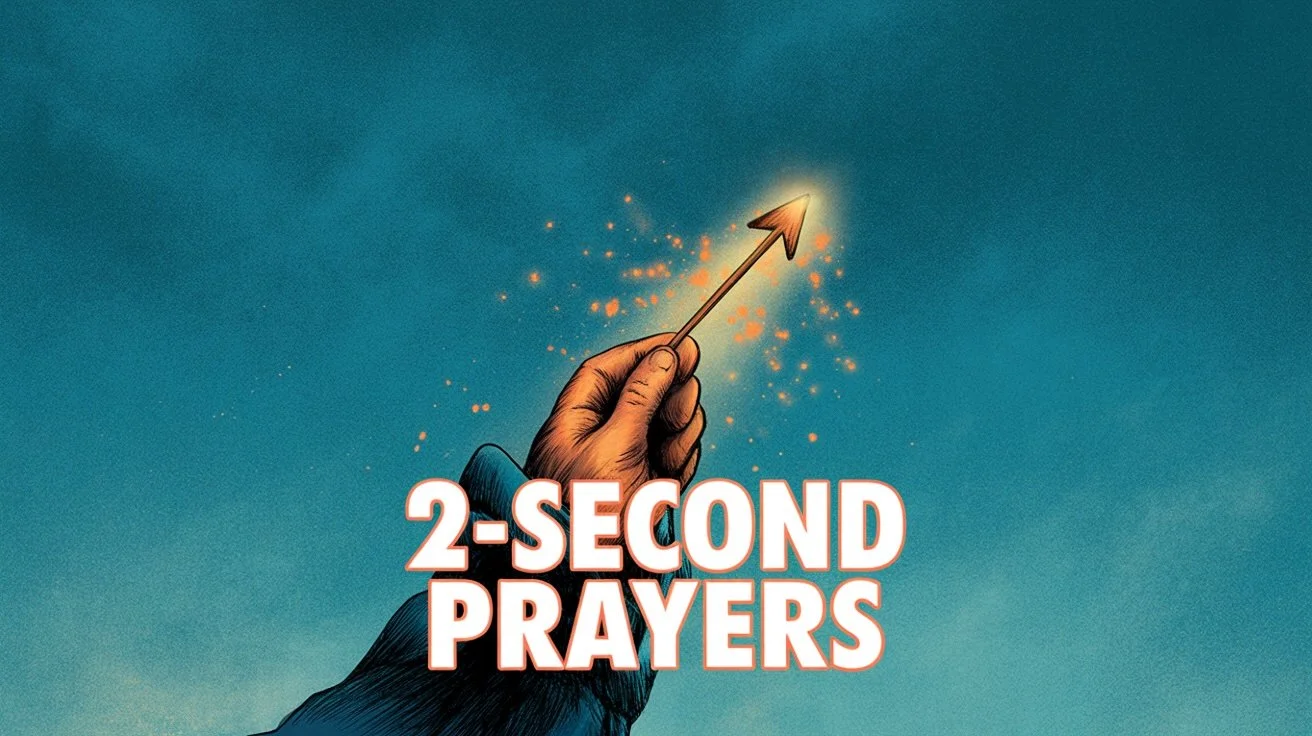
Arrow Prayers: The Two-Second Conversations That Change Everything
Key Passage: Then the king said to me, "What is it you want?" Then I prayed to the God of heaven, and I answered the king. — Nehemiah 2:4-5
Big Idea: You don't need a quiet room to talk to God—you need a willing heart in the chaos you're already standing in.
A quick word before we go deeper
Here's the thing about prayer that nobody warns you about: the guilt isn't usually about not praying. It's about not praying the way you think you should.
You know the scene. Morning alarm. Coffee. Rush. Kids or commute or both. And somewhere in the back of your mind, a whisper: I should've had a quiet time.
But what if the most powerful prayers you'll ever pray aren't the long ones?
What if God is less interested in your prayer posture and more interested in your prayer frequency?
This isn't about lowering the bar. It's about realizing the bar was never where you thought it was.
Nehemiah understood something most of us are still learning: prayer isn't preparation for life. Prayer is life. And sometimes it happens in two seconds flat, standing in front of someone who's waiting for your answer.
The moment you realize this is about you
Picture this: You're sitting in the meeting. Your boss just asked a question you weren't expecting. Your mind goes blank. Your palms go damp. You have maybe three seconds before the silence gets weird.
Or maybe it's this: Your kid just said something that broke your heart a little. You're standing in the kitchen holding a spatula, and you don't know whether to cry or respond or both. The moment demands something from you—and you've got nothing.
Or this: You're walking into the hospital room. The doctor's about to give news. You don't have time to journal. You don't have time to kneel. You barely have time to breathe.
These are the moments that expose the gap.
The gap between who we want to be spiritually and how we actually live when the pressure's on.
And here's the uncomfortable truth: most of life happens in the gap.
Most of your waking hours aren't spent in prayer closets. They're spent in traffic. In checkout lines. In tense conversations. In the thousand little in-between moments nobody writes worship songs about.
So the question isn't: How do I pray more?
The question is: How do I pray here?
The default belief that quietly drains people
Somewhere along the way, most of us absorbed an unspoken assumption about prayer:
Real prayer requires time, space, and the right conditions.
It sounds holy. It sounds reverent. And it's not entirely wrong.
But here's where it breaks down: if prayer requires ideal conditions, then most of your day becomes a spiritual dead zone.
You can't pause the presentation to light a candle. You can't ask your toddler to wait while you find your journal. You can't stop time when the argument gets heated and say, "Hold on, I need twenty minutes with Jesus."
So you don't pray.
Not because you don't want to. But because the conditions never feel right. And slowly, subtly, God becomes someone you visit instead of someone you live with.
The belief that prayer needs perfect conditions creates a faith that only works in theory.
And then the guilt kicks in.
You feel distant from God—not because He moved, but because you've been waiting for a door that was already open.
What the passage actually says when you slow down
Nehemiah 2 is a masterclass in what we might call arrow prayers—those fast, focused, mid-moment prayers that shoot straight to heaven like an arrow from a bow.
Here's the setup: Nehemiah is a Jewish man serving in the Persian empire, working as the cupbearer to King Artaxerxes. His job is to taste the king's wine, make sure it's not poisoned, and generally be pleasant company. Showing up sad was literally a risk to his life—Persian kings didn't tolerate gloom in their presence.
But Nehemiah had just received devastating news. Jerusalem's walls were destroyed. His people were in disgrace. His heart was wrecked.
And the king noticed.
"Why does your face look so sad when you are not ill? This can be nothing but sadness of heart."
Nehemiah says he was "very much afraid."
Then the king asked the question: "What is it you want?"
Now watch what happens in verse 4. The text gives us this stunning phrase:
"Then I prayed to the God of heaven, and I answered the king."
Did you catch that? Nehemiah didn't say, "Give me a moment, Your Majesty, I need to seek the Lord." He didn't ask for a recess. He didn't close his eyes or fold his hands.
He prayed and answered.
The prayer happened inside the pause. Between the question and the response. In the sliver of time where breath becomes words.
This wasn't a long prayer. It couldn't have been. The king was waiting. The moment was live. There was no time for paragraphs.
But here's what makes it profound: Nehemiah's two-second arrow prayer didn't come out of nowhere.
Earlier in chapter 1, we see Nehemiah weeping, fasting, and praying for days. He had history with God. He had rhythm. So when the crisis moment came, his instinct was to pray—not because he had time, but because prayer was already his reflex.
Arrow prayers aren't a substitute for deeper communion. They're the fruit of it.
They're what happens when someone has practiced the presence of God so often that calling out to Him becomes as natural as breathing.
Where this shows up in real life
Think of arrow prayers like spiritual muscle memory.
A concert pianist doesn't think about each finger when they're performing. They've practiced so long that their hands know where to go. The music flows because the work was done before the stage.
Arrow prayers work the same way.
You're not calculating theology in the moment. You're not constructing eloquent sentences. You're simply turning—fast, instinctive, desperate, hopeful—toward the God you already know.
Picture this: You're about to walk into a difficult conversation with a friend. You've rehearsed what you'll say. But right before you open your mouth, you exhale and whisper in your mind: Jesus, give me Your words.
That's an arrow prayer.
Or: Your anxiety spikes in the middle of a crowded room. Nobody knows. But inside your chest, you breathe: Lord, I'm not okay. Be my peace.
That's an arrow prayer.
Or: Your kid finally falls asleep after a brutal bedtime battle. You close the door and think: God, help me be more patient tomorrow. I don't have it in me.
That's an arrow prayer.
No ritual. No posture. No guilt about not doing it "right."
Just a heart that stays tethered to God—even in the chaos.
Five small practices for this week
1. Name your "Nehemiah moments."
Do this: At the end of each day, write down one moment where you felt caught off guard—emotionally, relationally, professionally. Just one.
Why it matters: You can't pray in the gap if you don't notice the gap. Awareness trains instinct.
Breath prayer: Lord, open my eyes to the moments I miss You.
2. Create a "trigger phrase."
Do this: Pick one short prayer you can default to when pressure hits. Something like "Help me, Lord" or "Jesus, be here" or "Father, I trust You." Memorize it until it becomes reflex.
Why it matters: When your brain short-circuits, having a default prayer keeps your heart aimed at God.
Breath prayer: When I can't find words, You still hear me.
3. Pray before you respond, not after.
Do this: The next time someone asks you a hard question or you feel tension rising, pause—just one beat—and silently ask God for wisdom before you speak.
Why it matters: Most of our regret comes from reacting instead of responding. A one-second prayer changes the trajectory.
Breath prayer: Slow me down, Lord. Let my words be Yours.
4. Use transitions as triggers.
Do this: Pick a daily transition—walking through a doorway, starting your car, opening your laptop—and attach a two-second prayer to it. Every time you do that action, pray.
Why it matters: Habits form through repetition and context. Anchoring prayer to movement builds it into your rhythm without adding time to your schedule.
Breath prayer: With every step, keep me close.
5. Pray your exhales.
Do this: When stress or fear hits, don't just "take a deep breath." Breathe out a prayer. Let the exhale carry a word to God: Peace. Help. Mercy. Jesus.
Why it matters: Your body and spirit are connected. Pairing breath with prayer turns a physical moment into a spiritual one.
Breath prayer: You are the air I breathe.
When this feels hard: the 3 pushbacks people feel
Emotional pushback: "It feels too small to count."
I get it. Two seconds doesn't feel like "real" prayer. It doesn't feel sacrificial or holy.
But consider this: a child who shouts "Dad!" when they fall doesn't question whether the call was long enough. They just reach. And the father responds.
God isn't counting syllables. He's counting hearts turned toward Him. And every arrow you send is a declaration: I need You. I remember You. I'm Yours.
That counts more than you know.
Practical pushback: "I forget to do it in the moment."
Of course you do. We all do. This isn't about perfection; it's about practice.
Nehemiah's instinct to pray came from months of prior communion. The goal isn't to be flawless—it's to keep building the reflex. Every time you remember after the fact, you're training yourself to remember sooner next time.
Grace for the learning curve. Always.
Theological pushback: "Doesn't God want my focused attention, not distracted scraps?"
Yes—and also, He wants you. All of you. The distracted, scattered, overwhelmed, mid-chaos version of you.
Arrow prayers aren't a replacement for longer seasons of prayer. They're a bridge. They're the way you stay connected between the mountaintop moments.
God isn't offended by your two-second prayers. He's moved by them. Because they prove that even when you have nothing else to give, you still turn to Him.
Questions You May Have
Q: Is it okay to pray with my eyes open?
Absolutely. Nehemiah was standing in front of a king. Eyes wide open. Heart wide open. There's no verse that says closed eyes make prayer count more. Pray on the train. Pray in the meeting. Pray while walking. God isn't checking your eyelids.
Q: What if I don't feel anything when I pray short prayers?
Feelings aren't the measure of faithfulness. Sometimes prayer is an act of will, not emotion. The arrow still lands even when your heart feels numb. Keep shooting.
Q: Can arrow prayers really make a difference in big situations?
Ask Nehemiah. His two-second prayer led to a king granting him permission, resources, and protection to rebuild an entire city. Big things often turn on small, faith-filled moments. Don't underestimate what God can do with your "Help me, Lord."
Reflection questions
What everyday moment this week felt spiritually "empty" but could have held an arrow prayer?
What default phrase could become your go-to prayer when stress hits?
Where have you been waiting for "ideal conditions" instead of praying in the chaos?
What transition in your daily routine could you attach a short prayer to?
How might your relationship with God change if you talked to Him twenty times a day for two seconds each?
A closing blessing
You don't have to wait for the quiet to come to God.
You can come now. Mid-sentence. Mid-crisis. Mid-mess.
He's not checking your posture. He's not grading your grammar. He's listening for the turn—the moment your heart tilts toward His.
So send the arrow.
It doesn't have to be pretty. It just has to be aimed at Him.
And here's what I believe for you: the more you practice this, the more you'll find that God was never far. He was just waiting for you to notice He was already in the room.
Go in peace. And pray on the move.

An Invitation to go Deeper….
If today’s message spoke to you, join the FaithLabz 30-Day Prayer Challenge and strengthen your connection with God’s unshakable love. You are never alone—let’s grow together!