DEC 15 | Holy Email Signatures: The Quiet Witness Hiding in Your Workday
Key Passage: "But in your hearts revere Christ as Lord. Always be prepared to give an answer to everyone who asks you to give the reason for the hope that you have. But do this with gentleness and respect." — 1 Peter 3:15 (NIV)
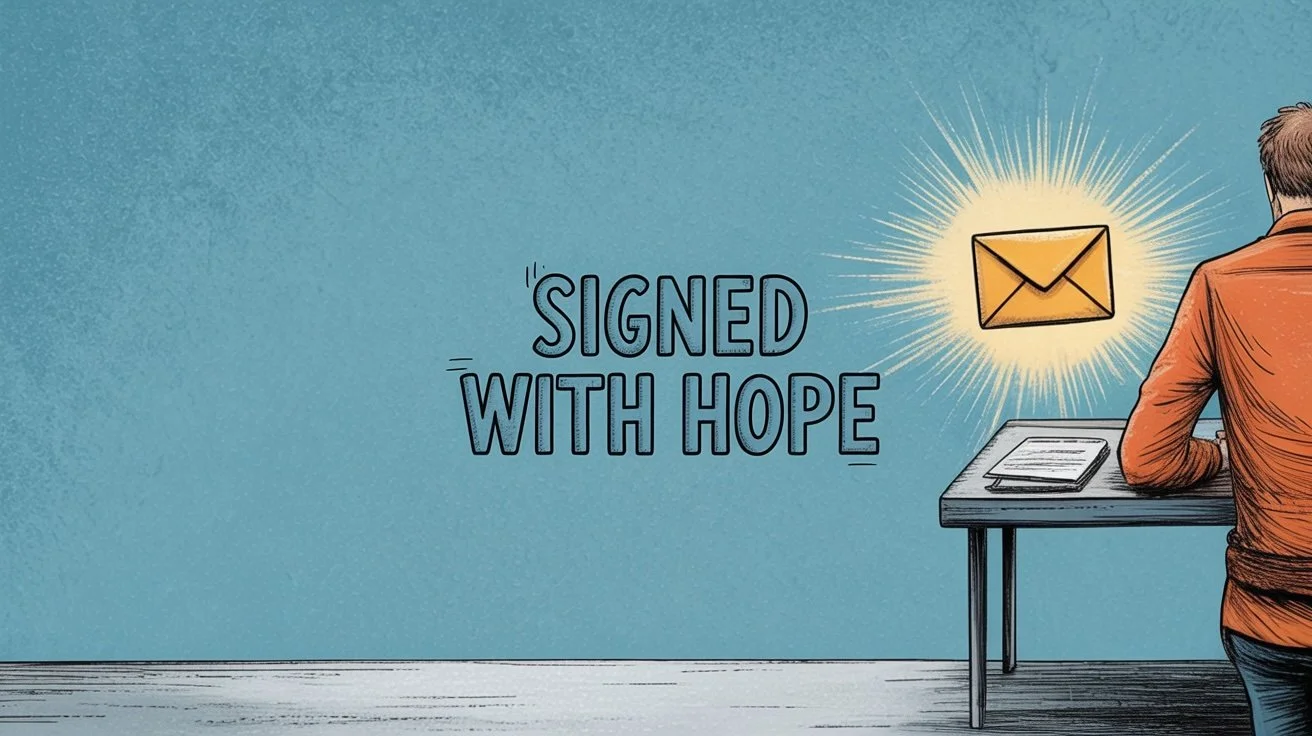
Big Idea: Your email signature isn't just contact info—it's a small canvas for quiet faithfulness in a noisy world.
What this will give you today: A fresh way to think about everyday work details as sacred ground, plus five practical ways to let your hope show without being weird about it.
Here's the thing about witness: most of us picture street corners and megaphones. We imagine bold declarations and dramatic conversions. And then we sit down at our desks on Monday morning, open Outlook, and feel like faith belongs somewhere else entirely.
But what if the most powerful witness isn't loud at all?
What if it's in the details—the tone of your reply, the way you close a message, the small signature block that goes out hundreds of times a year?
This isn't about slapping Bible verses on your corporate email (please don't do that without thinking it through). It's about something quieter. More honest. It's about the hope that leaks out of people who actually have it.
Let's talk about what that looks like in the inbox.
The moment you realize this is about you
You've sent the email. Again. The same sign-off you've used for three years. Best, [Your Name]. Or maybe Thanks, or Regards, or if you're feeling spicy, Cheers.
And it hits you: you've typed your name at the bottom of thousands of messages, and you've never once thought about what that signature communicates beyond logistics.
Meanwhile, you spend Sunday mornings thinking about how to live out your faith. You read books about being salt and light. You wonder why your work life feels so spiritually... beige.
Here's the tension: we want our faith to matter in real life, but we've been trained to compartmentalize. Sacred stays in the sanctuary. Secular gets the spreadsheets.
But Peter wasn't writing to monks. He was writing to scattered believers navigating Roman workplaces, difficult bosses, and daily tasks that felt utterly ordinary.
He told them to be ready—always—to explain their hope.
Not with a bullhorn. With gentleness. With respect.
What if that readiness starts in the smallest places?
The common assumption that quietly drains people
Most Christians assume that "witness" means saying Christian things to non-Christian people.
So we wait for the right moment. The vulnerable conversation. The crisis that opens a door. And while we wait, we keep our faith tucked away like a business card we never hand out.
The problem? That assumption turns witness into an event instead of an atmosphere.
It makes faith feel like a sales pitch we're perpetually nervous about delivering.
And here's what happens: we either become awkwardly aggressive (forcing conversations that feel manipulative) or awkwardly silent (acting like our faith is a secret we're slightly embarrassed by).
Neither one looks like hope.
Peter's instruction assumes something different. He assumes that people will already be curious. They'll notice something. They'll ask.
Which means the real question isn't "How do I bring up Jesus at work?"
It's "Am I living in a way that makes people wonder?"
Your email signature won't convert anyone. But the cumulative effect of hundreds of small, hope-shaped details? That's a different story.
What the passage actually says when you slow down
Let's sit with 1 Peter 3:15 for a minute, because it's doing more than we usually notice.
"But in your hearts revere Christ as Lord."
Peter starts inside. Before any external witness, there's an internal posture. Reverence. Lordship. This isn't about behavior management—it's about who sits on the throne of your actual life.
When Christ is Lord of your heart, that authority touches everything. Including your inbox.
"Always be prepared to give an answer..."
The word for "answer" here is apologia—a reasoned defense. But notice: Peter doesn't say always be pushing an answer. He says be prepared. Ready. Available.
This is witness as availability, not ambush.
"...to everyone who asks you..."
Here's the twist: Peter assumes people will ask. Why? Because he expects that genuine hope will be visible enough to provoke curiosity.
If no one ever wonders about your hope, it might not be because you're surrounded by uninterested people. It might be because your hope isn't showing.
"...to give the reason for the hope that you have."
Not the reason for your religion. Not the reason for your rules. The reason for your hope.
Hope is specific. It's personal. It's the thing that keeps you steady when everything wobbles. Peter says: know why you have it, and be ready to explain.
"But do this with gentleness and respect."
This is the guardrail. The tone matters as much as the content.
Gentleness means you're not trying to win an argument. Respect means you honor the dignity of the person asking—even if they're skeptical, even if they push back.
This is witness that doesn't bulldoze. It invites.
And here's what's remarkable: this verse doesn't tell you where the asking will happen. It could be at a dinner party. It could be in a hospital room.
Or it could be because someone noticed something different in the way you close your emails, handle conflict, or show up on a Monday.
Where this shows up in real life
Picture this: you're cc'd on an email thread that's gone off the rails. Two colleagues are sniping at each other. The tension is thick enough to screenshot.
You reply—not to take sides, but to de-escalate. You're clear, calm, professional. And you sign off with something small but deliberate: "Grace and peace, [Your Name]."
No one says anything. But someone notices.
Three weeks later, that same colleague catches you in the break room. "Hey, I've been meaning to ask—what's with your email sign-off? 'Grace and peace.' Where'd that come from?"
Door open.
Not because you were pushy. Because you were consistent. Because in a world of Best regards and passive-aggressive reply-alls, something about your presence felt... different.
This is the quiet witness of details.
It's not about being holier-than-thou. It's about being hopeful in places where cynicism is the default.
Your email signature is one detail. But it's a detail you control. A small, daily, repeated opportunity to let your hope leak out in a way that's gentle enough to invite questions instead of eye-rolls.
Five small practices for this week
1. Audit your current signature with fresh eyes
Do this: Open your email settings and read your signature like a stranger would. What does it communicate beyond logistics? Is there anything that reflects who you actually are—or is it purely functional?
Why it matters: Most of us set our signatures once and forget them. But this small block of text goes out with every message you send. It's worth being intentional about.
Breath prayer: Lord, let even my small details honor You.
2. Consider a sign-off that carries weight
Do this: Experiment with a closing phrase that feels authentic to your faith without being preachy. Options might include: Grace and peace, With hope, In gratitude, Pressing on, or even just Peace.
Why it matters: Your sign-off is the last thing people read. It lingers. A phrase rooted in hope can be a tiny seed planted in someone's Monday.
Breath prayer: Jesus, be in my last word as much as my first.
3. Add one line that invites curiosity
Do this: Below your name, consider adding a brief line—a favorite quote, a life motto, or a short phrase that reflects what anchors you. Keep it simple: "Hope is a discipline." or "Every day is a gift."
Why it matters: This isn't about being showy. It's about being you. A line that reflects your actual hope can spark real conversations.
Breath prayer: Father, give me words that open doors gently.
4. Pray before you hit send (at least once today)
Do this: Before sending one important email today, pause for five seconds. Ask God to use your words—and your name at the bottom—for His purposes.
Why it matters: This tiny habit re-sanctifies your work. It reminds you that even mundane communication is part of your calling.
Breath prayer: Holy Spirit, go with this message.
5. Watch for the ask
Do this: Pay attention this week. If anyone comments on your sign-off, your tone, or your demeanor—don't brush it off. Receive it as an open door, even if small.
Why it matters: Peter said people will ask. Your job is to notice when they do. Sometimes the question is subtle: "You always seem so calm." That's an invitation.
Breath prayer: Lord, help me recognize the open doors You set before me.
When this feels hard: the 3 pushbacks people feel
"This feels performative—like I'm trying to advertise my faith."
Honest concern. And you're right to be cautious—performative faith is exhausting for everyone involved.
But here's the difference: performance is about being seen. Witness is about being available. If your sign-off is designed to impress people with your spirituality, it'll feel hollow. But if it's simply an overflow of what's actually true about you, it's not performance—it's presence.
The question isn't "Will people notice?" It's "Is this authentically me?"
"My workplace is secular. This could backfire."
Fair. Some environments have stricter norms, and wisdom matters. You don't need to quote Romans in a government email.
But "grace and peace" isn't a sermon. "With hope" isn't a tract. There's a wide space between hiding your faith and being inappropriate. The goal is to find expressions that are genuinely you without being combative or out of place.
And sometimes, the most powerful witness is simply being kind when everyone else is stressed.
"Doesn't this reduce faith to something trivial? An email signature can't save anyone."
You're absolutely right—it can't. And we should hold this loosely.
But faithfulness in small things is still faithfulness. Jesus talked about mustard seeds for a reason. Your signature won't change the world. But it might be one small thread in a much larger tapestry God is weaving in someone's life.
We're not responsible for outcomes. We're responsible for showing up—gently, consistently, hopefully.
Questions people ask about this
Is it okay to put a Bible verse in my email signature?
It depends on your context. In some workplaces, this is perfectly normal and welcomed. In others, it might feel pushy or violate professional norms. A good test: would this create an uncomfortable power dynamic for someone who reports to you or depends on your approval? If so, consider something subtler. A phrase like "Soli Deo Gloria" or "With hope" can carry weight without feeling like a tract.
What if I work for a company that doesn't allow personal content in signatures?
Respect the policy. Your witness isn't limited to your signature—it's in your tone, your reliability, your kindness under pressure. An unsigned email sent with integrity is more powerful than a signed one sent with contempt.
How do I respond if someone actually asks about my sign-off?
Simply and warmly. You might say: "Oh, 'grace and peace' is a phrase from the letters in the New Testament—it's become meaningful to me as a reminder of what I'm grounded in." Then let them lead. If they're curious, they'll ask more. If not, you've planted a seed without forcing a harvest.
Reflection questions
What does my current email signature communicate about what I value?
If a stranger only knew me through my work emails, would they sense any hope in my presence?
What small phrase or sign-off would feel authentic to who I am in Christ?
When was the last time someone asked me about my hope—and did I recognize the moment?
How might I hold this practice loosely enough to stay genuine and tightly enough to stay intentional?
A closing blessing
You're going to send a lot of emails this week.
Most of them will be forgotten. Replied to, filed, deleted.
But the hope you carry doesn't depend on being remembered. It depends on being real.
So sign your name. Close the message. Let the small details do their quiet work.
And trust that the God who notices sparrows also notices signatures—and uses even the smallest offerings for purposes we'll never fully see.
Go in peace. Work in hope. And let your Monday be holy ground.

An Invitation to go Deeper….
If today’s message spoke to you, join the FaithLabz 30-Day Prayer Challenge and strengthen your connection with God’s unshakable love. You are never alone—let’s grow together!